
National Institute of Mass Communication & Journalism, Ahmedabad
( Affiliated to Gujarat University )
( Affiliated to Gujarat University )


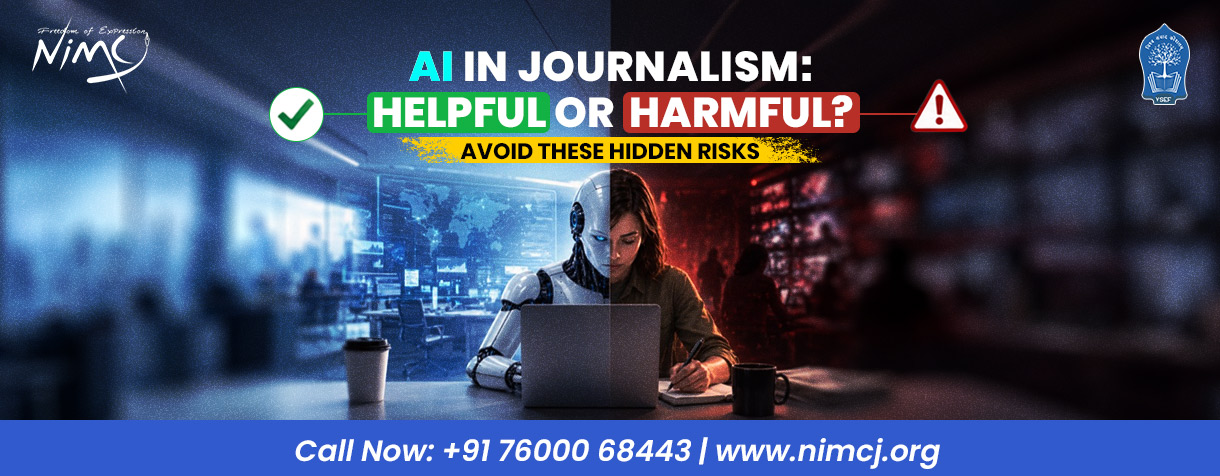
AI in journalism is no longer a future concept. It is happening right now, in newsrooms across the world. From generating automated match summaries to sorting through thousands of documents for investigative stories, AI tools are actively reshaping how reporters work.
However, this rapid adoption also comes with serious risks. Not every journalist fully understands those risks. Therefore, this blog explores both sides of the story: how AI is genuinely helping the media industry, and the hidden dangers that every journalist must avoid.
AI in journalism refers to the use of artificial intelligence tools to assist with writing, editing, researching, and distributing news content. Tools like ChatGPT, Google Gemini, and other AI platforms are now widely used in media organisations around the world.
According to the Reuters Institute Digital News Report, a growing number of publishers are experimenting with AI-generated or AI-assisted content. This shift is happening fast. Therefore, it is important for journalists, editors, and media students to understand both the opportunities and the responsibilities involved.
The stakes in journalism are always high. News influences public opinion. It shapes elections, policies, and social behaviour. So when AI enters this space, the impact can be enormous, for better or worse.
There is no denying that AI brings real advantages to the newsroom. When used correctly, it can save time, reduce manual effort, and improve content quality. Here are some of the most practical benefits.
Journalists often deal with massive volumes of information. AI tools can scan through thousands of documents, reports, and data sets within minutes. This is something that would take a human researcher several days.
For example, during investigative journalism projects like the Panama Papers or the Pandora Papers, AI-powered tools helped sort and analyse millions of leaked financial documents. Without AI assistance, processing that volume of data manually would have been nearly impossible.
Also, AI helps journalists track trends, monitor social media, and identify emerging stories faster than traditional methods allow.
AI tools like Grammarly and built-in AI editors help journalists refine their writing. They catch spelling errors, improve sentence structure, and suggest clearer phrasing. This is especially useful for reporters writing under tight deadlines.
AI can also create first drafts of structured, data-heavy stories. For instance, financial reports, sports scores, and weather updates are often auto-generated by AI in several international news organisations. The Associated Press, for example, uses AI to produce thousands of earnings report stories every quarter.
However, these drafts must always be reviewed and verified by a human journalist before publication. This step is non-negotiable.
Despite the benefits, AI in journalism carries serious risks. Many of these dangers are not immediately visible, which makes them even more threatening to journalistic integrity.
AI tools can sometimes generate completely false information. In the world of AI, this is called "hallucination." The AI does not know that it is wrong. It simply fills in gaps with plausible-sounding but incorrect details.
For example, an AI might confidently name a person as a witness to an event that never happened, or cite a study that does not exist. If a journalist publishes this without checking, it spreads as misinformation.
This is not a theoretical risk. It has already happened. Several reporters have faced public backlash after publishing AI-generated content that contained factual errors. Therefore, every piece of AI-generated content must be fact-checked against verified sources before it reaches the reader.
AI models are trained on large amounts of existing text from the internet. That text reflects existing human biases, including racial, gender, political, and cultural biases. As a result, AI tools can unintentionally produce biased content.
A journalist relying too heavily on AI may unknowingly publish content that favours one group over another, reinforces stereotypes, or misrepresents communities. This is a serious ethical concern in a profession that is meant to be fair, balanced, and accurate.
This is the most important section of this blog. AI is a powerful assistant, but it does not think. It predicts. There is a fundamental difference between the two.
Human journalists bring curiosity, empathy, ethical judgment, and lived experience to their reporting. They can smell a story. They can sense when something does not add up. They understand the cultural context of a community. AI cannot do any of this, no matter how advanced it becomes.
One of the most talked-about examples of AI misuse in journalism came when a well-known national newspaper published an article and accidentally left an AI editing prompt visible within the published text. The prompt, which was something along the lines of instructions given to the AI tool to rewrite or improve the text, appeared in the final article instead of the finished content.
The blunder went viral. Readers immediately took screenshots and shared them across social media. The newspaper faced widespread trolling and a significant loss of credibility. This real incident is a clear reminder that AI output must always go through rigorous human review before publication. It also shows that over-reliance on AI without proper editorial oversight can embarrass even well-established media organisations.
AI can help you find data and draft content. However, it cannot replace the journalist's core responsibility: to verify facts and report the truth.
Before using any AI-generated content, every journalist must cross-check the information with primary sources, official records, or first-hand interviews. Fact-checking is not optional. It is the foundation of credible journalism. No AI tool, however advanced, can carry that responsibility.
Trust is the most valuable asset any news organisation has. Once it is lost, it is very difficult to rebuild.
When readers discover that a story contains AI-generated errors or unverified information, they do not just lose trust in that article. They lose trust in the entire publication. Also, search engines like Google increasingly reward content that demonstrates expertise, authoritativeness, and trustworthiness (E-E-A-T). AI-generated content that lacks human editorial review often fails to meet these standards.
Therefore, publications that use AI must be transparent about it. Many leading organisations now label AI-assisted content clearly so that readers are informed.
Using AI responsibly in journalism is not complicated. It simply requires clear guidelines and a commitment to editorial standards. Here is how journalists and newsrooms can do it well.
AI should be used to assist, not to replace. Journalists should use AI for research support, initial drafts, data analysis, translation assistance, and grammar improvements. However, the final judgment on every story must come from a human journalist.
Every AI-generated claim must be verified before publication. If the AI says a certain statistic or quote exists, the journalist must find the original source and confirm it independently.
Newsrooms should also develop internal AI usage policies. These policies should define when AI can be used, how outputs should be reviewed, and how AI assistance should be disclosed to readers.
Training is equally important. Media schools like NIMCJ play a vital role in preparing the next generation of journalists to understand both the capabilities and the limitations of AI tools.
AI in journalism has the potential to make newsrooms more efficient, stories more data-driven, and reporters more productive. However, it is not a replacement for human intelligence, ethical judgment, or journalistic integrity.
The hidden dangers of AI, including misinformation, bias and editorial carelessness, are real. The viral prompt blunder is proof that even established outlets are not immune. Therefore, every journalist must treat AI as a helpful assistant and not as a decision-maker.
Use AI to spell-check. Use it to find data faster. Use it to draft. But always verify, always think critically, and always let human judgment have the final word. That is what separates a journalist from a machine.
As the media industry evolves with AI, the need for skilled, ethical, and well-trained journalists is more important than ever.
NIMCJ (National Institute of Mass Communication & Journalism), is one of India’s leading media institutes, offering practical training in journalism, digital media, advertising, and corporate communication. With industry-focused learning, expert faculty, and real-world exposure, NIMCJ prepares students to succeed in the modern media landscape.
Apply now for BAJMC and MAJMC admissions and take the first step toward building a strong and future-ready journalism career.
Read Next Blog: Top Mistakes Beginners Make in Journalism and How to Avoid Them
15 Apr 2026
Post by : NIMCJ