
National Institute of Mass Communication & Journalism, Ahmedabad
( Affiliated to Gujarat University )
( Affiliated to Gujarat University )


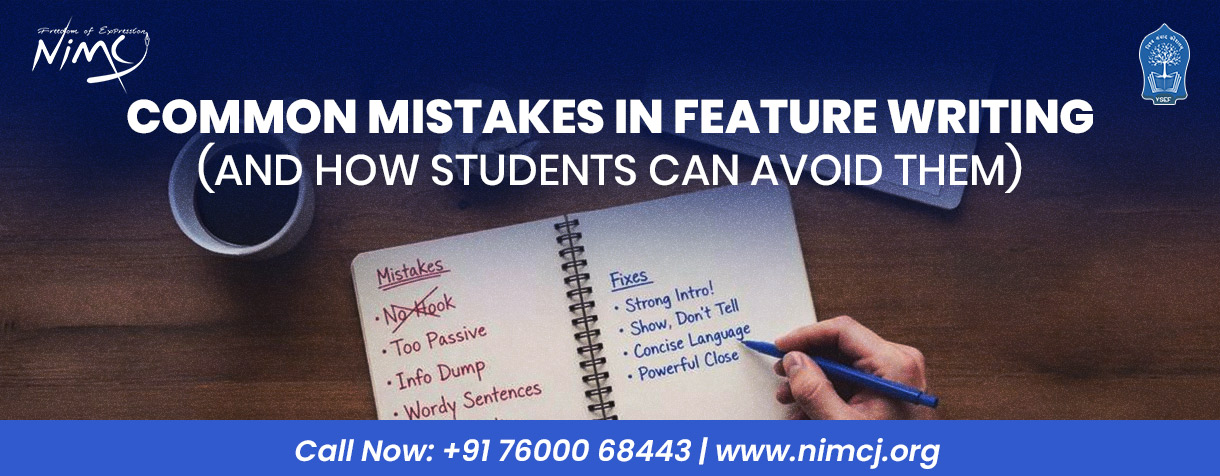
Feature writing is one of the most creative and engaging forms of journalism. Unlike hard news, it allows writers to explore human emotions, storytelling techniques, and deeper context. However, many journalism and mass communication students struggle with feature writing — not because they lack creativity, but because they make avoidable mistakes.
If you are pursuing journalism or a mass communication course, understanding common mistakes in feature writing can significantly improve your writing quality and academic performance.
This guide highlights:
Feature writing requires more than just information. It demands:
Many students either treat it like news writing or turn it into opinion writing. Both approaches reduce the effectiveness of a feature story.
Also Read: What is Feature Writing? Types, Examples and Importance
1. Weak or Boring Introduction (Lead)
The introduction is the most important part of a feature story. Many students start with dull, textbook-style openings.
Common Mistake Example:
“Pollution is a major problem in India today.” - This sounds like an exam answer, not a feature story.
Improved Version:
“Every morning, 12-year-old Aarav walks to school wearing a mask - not because of a virus, but because the air outside his home in Ahmedabad is too toxic to breathe.”
Why this works: It creates curiosity and emotional connection.
2. No Clear Angle or Focus
Feature writing needs a specific angle. Beginners often try to cover everything about a topic.
Mistake:
Writing broadly about “Education in India” without a central focus.
Solution:
Choose a specific angle like:
A clear angle keeps the story focused and engaging.
3. Overloading with Facts Instead of Storytelling
Feature writing is not a data dump. Students sometimes include too many statistics without context.
Writing Mistake to Avoid:
Listing five statistics in one paragraph without explaining their relevance.
Better Approach:
Use data to support storytelling — not replace it.
Example:
Instead of only saying “Air pollution increased by 20%,” connect it to how it affects daily life.
4. Writing Like a News Report
Feature writing mistakes often happen when students use rigid news structure.
News:
Feature:
If your feature reads like a breaking news report, you need to revise.
5. Too Much Opinion, Too Little Reporting
Feature writing is not personal blogging.
Mistake:
“I think the government should change the system immediately.”
Correction:
Use expert opinions, interviews, or documented evidence instead of personal bias.
Journalism demands credibility.
6. Poor Research and Weak Interviews
A feature story becomes powerful when supported by:
Students often rely only on internet research.
How to Avoid:
7. Ignoring Structure and Flow
A feature story should have:
Random paragraphs without transition reduce readability.
8. Using Complex Language or Jargon
Some students think difficult vocabulary makes writing professional.
Example:
“The socio-economic paradigm necessitates systematic intervention.”
Simpler Version:
“The economic situation requires immediate action.” - Clarity is more powerful than complexity.
9. Lack of Emotional Connection
Feature writing connects with readers emotionally. If your story feels cold or mechanical, it will not engage readers.
Add:
10. Weak or Abrupt Conclusion
Many students end their feature suddenly without impact.
Mistake:
“That is the situation in India today.”
Better Ending:
Return to the opening scene or leave readers with a powerful thought or forward-looking statement.
Weak Version:
“Farmers are facing problems due to lack of rainfall. Many crops are destroyed.”
Improved Feature Version:
“Standing in his cracked field, Rameshbhai looks at the sky for answers. For the third consecutive year, the rains have failed his village.”
Notice how the second version:
Media students often lose marks because they:
Always proofread before submission.
If you are pursuing a journalism or mass communication course, follow these practical steps:
1. Read Quality Features
Read publications like The Hindu Sunday Magazine, Indian Express Features, or long-form digital platforms.
2. Practice Scene Writing
Describe everyday situations creatively.
3. Interview Real People
Practice asking open-ended questions.
4. Rewrite Your Work
Editing improves clarity and storytelling.
5. Build a Portfolio
Create a blog or publish college magazine features.
Mastering feature writing:
For students pursuing a Mass Communication and Journalism course, feature writing is a core skill across print, digital media, and broadcasting.
What are common feature writing mistakes?
Weak introduction, lack of focus, excessive data, poor structure, too much opinion, and weak conclusion.
How can students avoid feature writing mistakes?
By focusing on storytelling, conducting proper research, using interviews, maintaining structure, and practicing regularly.
What is the biggest mistake in feature writing?
Not having a clear angle or engaging lead.
Is feature writing different from news writing?
Yes. Feature writing focuses on storytelling and human interest, while news writing focuses on immediate facts and events.
Feature writing is both an art and a discipline. Avoiding common writing mistakes can transform an average article into a powerful, engaging story.
If you want to build strong storytelling skills and practical media expertise, structured training in journalism and mass communication plays a vital role in professional growth.
Ready to sharpen your feature writing skills and build a strong foundation in journalism?
Join NIMCJ and learn storytelling, reporting, and media practices through hands-on training and real newsroom exposure.
Apply now for admissions at NIMCJ and take the first step toward becoming a confident, professional media communicator.
Read Next Blog: Barriers to Communication: Types, Examples and How to Overcome Them
17 Feb 2026
Post by : NIMCJ