National Institute of Mass Communication & Journalism, Ahmedabad
( Affiliated to Gujarat University )
( Affiliated to Gujarat University )


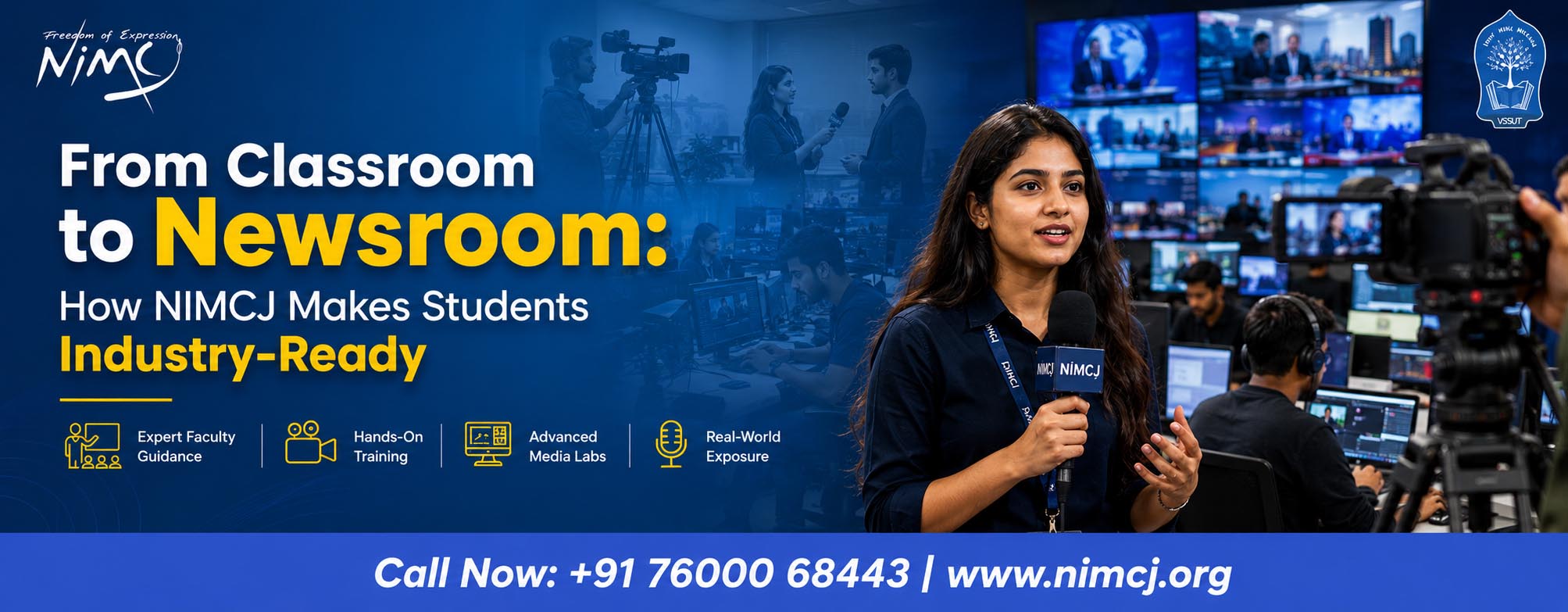
Every journalism aspirant dreams of moving confidently from classroom to newsroom. However, this shift rarely happens on its own. It takes the right training, mentorship, and real-world exposure. NIMCJ, the National Institute of Mass Communication and Journalism in Ahmedabad, has built its entire teaching philosophy around this transition. In this blog, we explore how NIMCJ prepares students for real media jobs, look at the history of journalism in India, and explain why journalism remains a rewarding career choice today.
Journalism and mass communication is the discipline of gathering, verifying, and sharing information with large audiences. It covers print, television, radio, and digital platforms. The field also includes advertising, public relations, and corporate communication.
Students who study journalism and mass communication learn more than reporting. They learn storytelling, ethics, research, and multimedia production. Therefore, this degree opens doors across several industries, not just newsrooms.
Understanding the history of journalism in India helps students appreciate the responsibility that comes with the profession. Indian journalism has shaped public opinion for over two centuries.
Journalism in India began in 1780 with James Augustus Hicky's Bengal Gazette, also called the Calcutta General Advertiser. The paper criticized British officials openly. As a result, the British shut it down within two years.
Soon after, other papers followed, including the Bengal Journal and the Madras Courier. However, colonial authorities imposed strict censorship laws throughout the early 1800s to control the press.
The Revolt of 1857 changed Indian journalism forever. Indian-owned newspapers grew rapidly after this period. Leaders like Raja Ram Mohan Roy used the press to push for social reform.
Later, Mahatma Gandhi and other freedom fighters used newspapers as tools for mobilizing public support. The Vernacular Press Act of 1878 tried to silence these voices, but nationalist journalism only grew stronger.
After independence, All India Radio and Doordarshan became major broadcasters. Economic liberalization in 1991 opened India to satellite television and private news channels.
Today, digital platforms dominate the news landscape. Journalists now report, shoot, edit, and publish content across multiple formats. This evolution makes practical, technology-driven training essential for new journalists.
Many students ask, "is journalism a good career in India?" The honest answer is yes, provided you build the right skills. The media industry continues to grow through digital news, OTT platforms, and corporate communication.
A journalism and mass communication degree opens many paths. Graduates work as reporters, news anchors, content writers, and social media managers. Others move into public relations, corporate communication, or documentary filmmaking.
Digital growth has created fresh roles too. These include video producers, podcast hosts, and data journalists. Consequently, students today have far more career choices than journalists had a decade ago.
Entry-level salaries in journalism typically range between three and six lakh rupees annually in India. Naturally, pay improves with experience, specialization, and a strong portfolio. Journalists who build skills in digital reporting and multimedia storytelling tend to grow faster.
Career security in this field now depends on adaptability. Editors increasingly value practical skills over theoretical knowledge alone.
This is where NIMCJ makes a real difference. The journey from classroom to newsroom requires more than textbook learning. NIMCJ was built specifically to close this gap between academic study and actual media work.
NIMCJ believes students learn best by doing. Classrooms are supported by studios, editing labs, and radio equipment. Students practice reporting, anchoring, and production regularly, not just before exams.
This approach helps students build confidence early. By graduation, they already have real work samples to show employers.
NIMCJ regularly invites media professionals for guest sessions and workshops. These sessions expose students to real newsroom challenges and expectations. Guest experts also share practical tips that textbooks often miss.
Additionally, NIMCJ runs a weekly discussion platform where students debate current issues openly. This builds the critical thinking every journalist needs.
Internships form a core part of the NIMCJ learning model. Students get placed with newspapers, television channels, and digital media houses during their course. This exposure teaches deadline pressure, editorial judgment, and teamwork.
Many students also participate in Accendo, an in-house initiative where they manage a media project from concept to execution. This mirrors real newsroom responsibilities closely.
NIMCJ offers focused specializations in print journalism, electronic media, digital media, and advertising. Each track builds specific, job-ready skills. For instance, digital media students learn content strategy and social media reporting.
This specialization model ensures graduates enter the job market with clear, marketable expertise. Employers notice this readiness during interviews.
NIMCJ offers structured journalism courses affiliated with Gujarat University. Both programs combine theory with consistent practical training.
The Bachelor of Arts (Hons.) in Journalism and Mass Communication is a four-year undergraduate program. It suits students starting right after Class 12. The course builds foundational skills in writing, reporting, and media ethics.
The Master of Arts in Journalism and Mass Communication is a two-year postgraduate program. It suits graduates aiming for leadership roles in media. The course blends professional training with a liberal arts perspective on society and ethics.
NIMCJ runs an active placement cell that connects students with national and regional media houses. The institute has earned recognition from the Government of Gujarat for excellence in placement.
Notably, NIMCJ alumni now work at organizations like ABP News, CNBC TV18, ANI, and Divya Bhaskar. This track record shows how effectively NIMCJ moves students from classroom to newsroom in practice, not just in theory.
Several factors make NIMCJ a strong choice among journalism colleges in India. First, NIMCJ pioneered radio journalism and digital media education in Gujarat. Second, India Today has ranked NIMCJ among India's best mass communication institutes consecutively from 2019 to 2026.
Furthermore, Outlook Magazine also recognized NIMCJ's national ranking between 2018 and 2021. NIMCJ additionally offers academic pathways from undergraduate study through to a PhD, giving students long-term academic flexibility within one institute.
Journalism remains a meaningful, evolving career in India. However, success depends on training that matches real industry demands. NIMCJ's model of hands-on learning, mentorship, and internships shows exactly how a college can guide students from classroom to newsroom successfully.
If you are exploring journalism courses in India, consider an institute that prioritizes practical exposure alongside academics. NIMCJ has spent over a decade doing precisely that for its students in Gujarat, India.
It refers to NIMCJ's teaching approach, which combines academic learning with hands-on training, internships, and mentorship so students are ready for real media jobs at graduation.
Yes. Journalism offers strong growth through digital media, OTT platforms, and corporate communication, alongside traditional print and broadcast roles.
NIMCJ offers a four-year BAJMC (Hons.) undergraduate program and a two-year MAJMC postgraduate program, both affiliated with Gujarat University.
NIMCJ combines practical training, industry mentorship, strong placement support, and national rankings by India Today and Outlook Magazine.
No. Students from any stream, including arts, commerce, or science, can apply for journalism courses after completing Class 12.
BAJMC (Hons) and MAJMC Admissions for 2026-2027 are now open. Call Now: 7600068443
Your Next Step Starts Here: Inquiry Now
03 Aug 2026
Post by : NIMCJ