National Institute of Mass Communication & Journalism, Ahmedabad
( Affiliated to Gujarat University )
( Affiliated to Gujarat University )


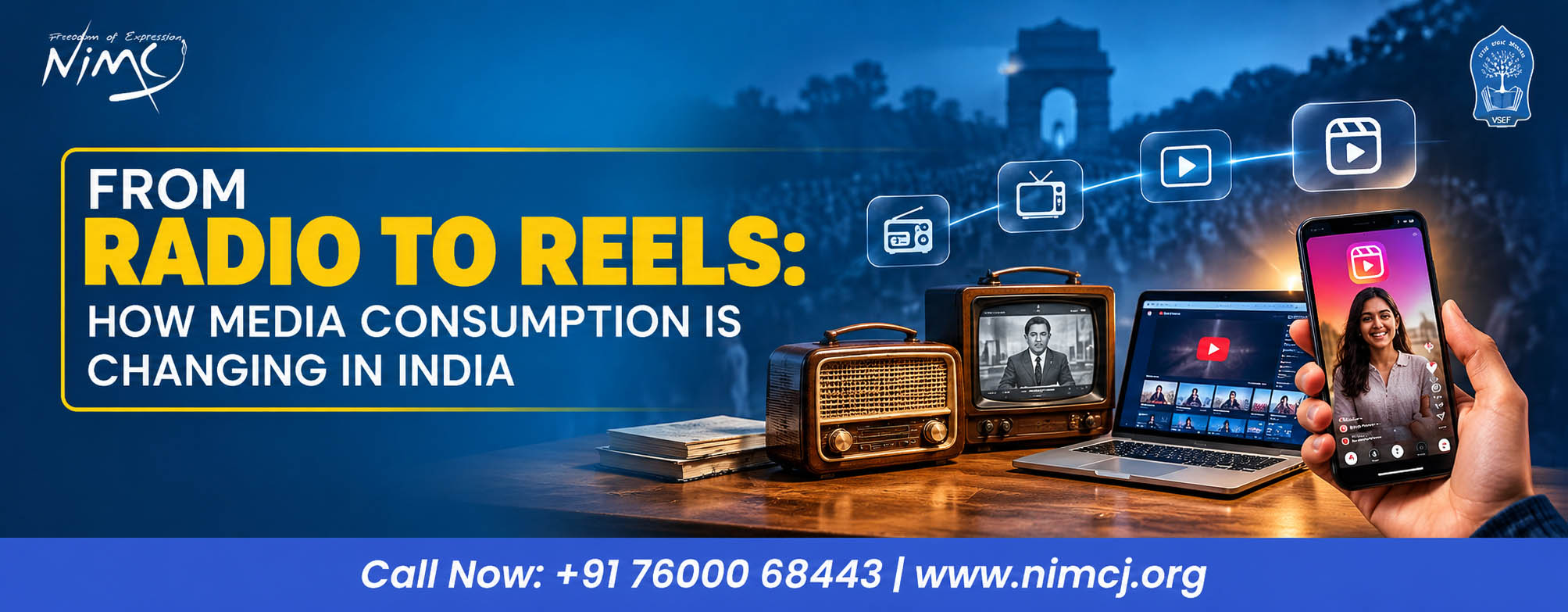
Remember sitting down with your family to listen to your favourite show on the radio? It could be hearing a familiar voice, a jingle, or cricket commentary that could really make your evening.
Radio became a powerful way to connect millions of Indians. However, as technology advanced, TV became a huge part of everyone’s lives. Newspapers, film, and eventually now the Internet.
Today, we use our smartphones as our television, newspaper, music player, and sometimes even our main source of news! By scrolling through Instagram Reels and YouTube Shorts for just a few seconds, we can see the latest news, what’s entertaining us, and what’s trending globally. We can also see creators from all over the world.
So, how has India moved from listening to the radio to watching endless reels?
Let’s look at how.
Before the age of smartphones and streaming channels, radio was one of the most influential forms of mass communication in India.
With news bulletins on All India Radio and popular shows on Vividh Bharati, radio became a fun, educational and informative way to entertain people.
Private FM radio arrived in India in the early 1990s. It helped build a connection between the presenters and audience. Radio jockeys became familiar, music shows had loyal audiences, and community radio gave local communities a voice.
Radio was very accessible. People could listen whilst driving, working, cooking and relaxing. There was no need to spend money on expensive equipment or have an internet connection. Just a radio!
Even today, radio stays relevant with FM radio, community radio, and digital audio.
Also Read: Radio Jockey: Fun Career to Make in Entertainment Industry
Television took media consumption to the next level.
Doordarshan became a huge part of family life in India. Shows like Ramayan, Mahabharat, and news bulletins became very popular.
Private TV channels led to more variety. With news channels, music channels, regional entertainment and reality shows.
Unlike radio, television was able to tell stories using an audio-visual medium.
It also changed how brands advertised, how news was reported and how entertainment was produced. Brands could show their products, reporters could report using live visuals, and the viewers could experience events as they happened.
Television set the foundations for a visual media-driven culture in India.
Related Guide: How is television effective in mass communication
The introduction of cheap internet and smartphones became a huge turning point in recent years.
Previously, people had no choice but to rely on broadcasting or publishing. However, digital media has changed this.
People can now visit news sites, read blogs, listen to podcasts, scroll through videos, and social media sites whenever they please.
YouTube, Facebook, Instagram and OTT sites have become more popular.
People can now watch their favourite shows instantly. They no longer have to wait for shows to air on TV. They can also access breaking news through mobile apps, instead of buying newspapers.
Media consumption has become more instant.
This has also provided opportunities to independent journalists, content creators, digital marketers, and new media professionals.
One of the most noticeable changes in digital media consumption in India is the rise of short-form content.
Instagram Reels, YouTube Shorts, etc. have changed how we consume information and entertainment.
Besides entertainment, there are many educational videos, news explanations, product reviews, social awareness campaigns, and career advice available on Reels and Shorts.
This has changed how audiences are involved in creating content.
India's internet population prefers to use smartphones for content consumption.
According to the Reuters Institute Digital News Report 2026, online platforms are a huge source of news in India, with social media being a major part of how people find their news.
Meta’s 2026 research shows that Reels are becoming more popular with urban and rural audiences. At least 97% of surveyed users watch videos on their platforms daily, reflecting the country’s rapid move toward mobile-first, video-first behaviour. Daily video engagement is now nearly identical across urban India (98%) and rural India (94%)
This is due to the demand for content that is easy to access, engaging, visually appealing and relevant.
The rise of Netflix, Amazon Prime Video, JioHotstar, and more has changed how we consume entertainment.
According to the Ormax OTT Audience Report 2026, there are around 665 million OTT users in India. This is an 11% increase from last year.
Audiences can now watch films, web series, documentaries, and regional content. They no longer have to rely on traditional TV.
Media consumption is becoming multi-screen with more connected smart televisions.
One of the most fascinating developments in India's internet media is the rise of regional content.
Podcasts, comedy videos, web series, and news channels in different regional languages are now much easier to access through digital platforms.
This is important as India is a very diverse country in terms of language.
People want to see content that reflects their culture, language, experiences, and interests. Regional creators are providing this with relatable content and relevant information.
Previously, people relied on newspapers, TV bulletins, and radio for accurate information.
Now people can watch news on social media to reach millions of people.
While this makes information more accessible, it can cause issues with misinformation, fake news, edited visuals, and clickbait.
This means it is more important than ever to be media literate, fact-check, and practice responsible journalism. People need to ask questions and fact-check.
This shows aspiring journalists the importance of ethical reporting, digital storytelling and strong editorial skills.
The evolution of media from radio to reels has opened up many new career opportunities in mass communication and journalism.
The modern media industry requires people who understand traditional communication methods and new digital technologies.
Some of the careers that are becoming more popular are:
India has come a long way from radio to endless Instagram Reels. This shows how far society, technology and communication have evolved.
However, despite all this, we all want to be informed, entertained, connected and inspired.
Radio gave us voices, TV gave us visuals, the internet gave us access, and social media has given us involvement. Emerging technologies are giving us more personal and interactive media experiences.
As India evolves to become a more digital country, we need to create content that is meaningful, credible and responsible.
There are many opportunities to learn about the different aspects of media through journalism, radio, and more at the National Institute of Mass Communication and Journalism (NIMCJ), Ahmedabad.
Explore Courses at NIMCJ.
03 Nov 2026
Post by : NIMCJ