
National Institute of Mass Communication & Journalism, Ahmedabad
( Affiliated to Gujarat University )
( Affiliated to Gujarat University )


Think about the last time you texted a friend, watched a news bulletin, or listened to a radio jingle on your morning commute. All of these are acts of communication. And yet, most of us never stop to think about how communication actually works.
Communication is the backbone of human civilisation. From the earliest cave paintings to today's viral Instagram reels, every form of expression follows a process. It is a structured journey that a message takes from one person to another.
For students of mass communication, journalism, advertising, and media studies, understanding this process is not just academic knowledge. It is the very foundation of your craft. Whether you are writing a news story, designing an ad campaign, or anchoring a live show, you are always working within the process of communication.
Let's break down the entire process of communication in a simple, easy-to-understand way. We cover all elements, models, real-life examples from Indian media, and clear explanations of every component.
The process of communication is the step-by-step method through which a message is created, sent, received, and understood between two or more people. It is not a one-time event. It is a continuous, dynamic exchange that involves multiple stages and participants.
Definition: The process of communication refers to the transmission of a message from a sender to a receiver through a medium or channel, where the message is encoded by the sender, decoded by the receiver, and a response is generated in the form of feedback.
Simply put, communication is like a game of cricket. The bowler (sender) bowls the ball (message), the batsman (receiver) tries to read the delivery (decodes), plays a shot (feedback), while the crowd noise (interference or noise) may affect how well everyone communicates on the field.
The process of communication applies to all forms of communication. This includes interpersonal communication (one-on-one conversations), group communication, mass communication (newspapers, TV, radio, social media), and organisational communication.
Before we look at the diagram or the steps, it is important to know what the elements of the communication process are. There are nine core components, and each one plays a vital role.
The sender is the person or entity who initiates the communication. The sender has a thought, idea, or information they want to share with someone else. The sender is also known as the communicator or encoder. Example: A news anchor on NDTV reporting a breaking story is the sender.
Encoding is the process of converting the sender's idea into a form that can be transmitted. This could be words, images, sounds, gestures, or symbols. The sender packages the message in a way the receiver can understand. Example: A journalist converts a complex economic policy into simple, readable language for a newspaper article.
The message is the actual content of communication. It is the information, idea, emotion, or opinion being transmitted. It can be verbal (spoken or written) or non-verbal (gestures, facial expressions, visuals). Example: A 30-second television advertisement promoting a new product is the message.
The channel is the medium through which the message travels from the sender to the receiver. It could be air (for speech), paper (for print), a screen (for TV or digital), or radio waves. In mass communication, the channel is the media platform itself. Example: A WhatsApp forward, a newspaper, a radio broadcast — each is a different channel.
The receiver is the individual or group for whom the message is intended. The receiver is also called the audience or decoder. The receiver's background, knowledge, culture, and mood all affect how they interpret the message. Example: A reader who picks up today's edition of Divya Bhaskar is the receiver.
Decoding is the process by which the receiver interprets and makes sense of the message. It is the reverse of encoding. The receiver uses their knowledge, experience, and cultural context to understand what the sender meant. Example: A viewer watching a Hindi news report understands the political update being discussed.
Feedback is the receiver's response to the message. It tells the sender whether the message was received and understood correctly. Feedback can be immediate (a nod, a reply) or delayed (a letter to the editor, a comment online). Example: Viewers calling a TV debate show to share their opinion is feedback.
Noise is anything that distorts, disrupts, or interferes with the message during its transmission. It can be physical (loud background sounds), psychological (biases), semantic (language barriers), or technical (poor internet connection). Example: A poor phone signal during a live TV interview causing the audio to break is noise.
Context refers to the environment, situation, or circumstances in which communication takes place. The same message can mean different things in different contexts, whether social, cultural, physical, or historical. Example: A satirical cartoon about a politician reads differently during an election season than at other times.
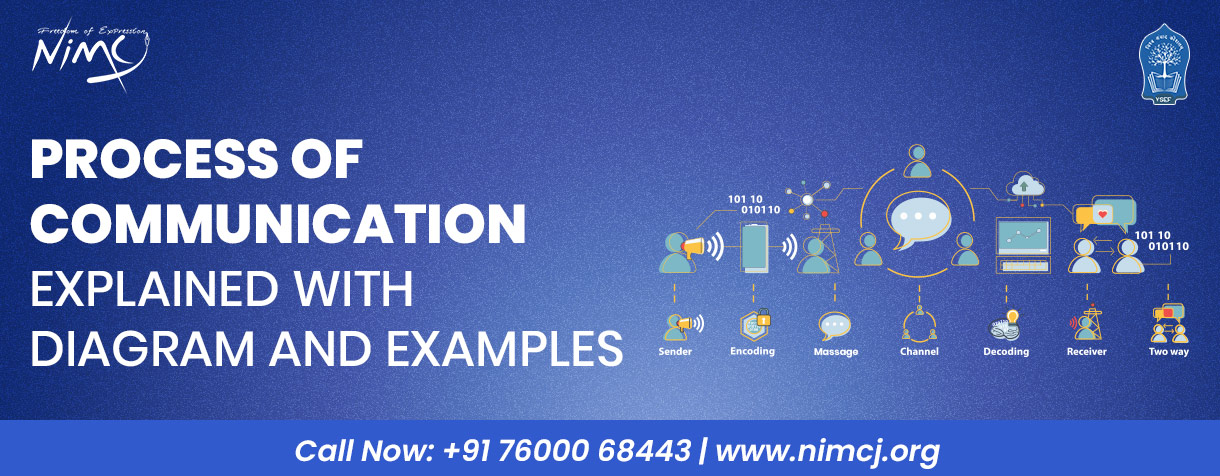
The process of communication follows a clear flow. The sender forms an idea and encodes it into a message. The message is then transmitted through a channel. The receiver decodes the message and interprets its meaning. The receiver then sends feedback back to the sender. At any point in this flow, noise can disrupt or distort the message.
Flow: Sender → Encoding → Message → Channel → Decoding → Receiver → Feedback (back to Sender)
Noise can interfere at any stage of this process.
This is the linear model of communication. As we move further in this blog, you will see how other models depict a more dynamic and two-way view of communication.
As Shannon and Weaver noted, communication is only effective when the receiver decodes the message in the same way the sender intended it.
Now that we know the elements, let us walk through the 5 steps of the process of communication in a logical sequence. Each step builds on the previous one.
Every act of communication begins with an idea, thought, or feeling in the sender's mind. The sender identifies what they want to communicate and to whom. This is the most critical step, because if the idea itself is unclear, everything that follows will suffer.
Example: A TV news producer decides to cover the story of rising fuel prices affecting daily commuters in Ahmedabad.
Once the idea is clear, the sender must encode it. This means converting the idea into a form that can be transmitted, whether spoken words, written text, visuals, audio, or a combination. The encoding process is influenced by the sender's language, culture, education, and intent.
Example: The reporter scripts the news story, the cameraperson captures visuals of fuel stations and commuters, and an editor assembles the package.
The encoded message is then transmitted through a channel. The choice of channel affects how the message is received. A WhatsApp message feels more personal than a newspaper headline. A radio announcement reaches a different audience than a YouTube video.
Example: The news package is broadcast on a Gujarat-based news channel during prime time at 9 PM.
The receiver receives the message and begins to decode it. This means interpreting and making sense of what was sent. Decoding is shaped by the receiver's language, culture, past experiences, and the context in which they are viewing the message.
Example: Viewers watching the news package understand that petrol prices have gone up and this is affecting auto-rickshaw drivers and daily commuters.
The final step is feedback, which is the receiver's response to the message. Feedback confirms that communication has taken place and tells the sender whether the message was understood correctly. In mass communication, feedback may be delayed, but it is always crucial.
Example: Viewers call the TV channel's helpline to share their views on the fuel price issue, or the story trends on social media with thousands of comments.
The process of communication does not always work the same way. Scholars have described it in three broad types based on how the participants interact.
In the linear model, communication flows in one direction only, from sender to receiver, with no immediate feedback. It is the simplest model and best suits mass communication like television broadcasts, newspaper articles, and radio shows.
Example: A Doordarshan broadcast during Independence Day. The information flows from the broadcaster to millions of viewers with no immediate two-way interaction.
The interactive model adds the element of feedback to the linear model. Communication goes from sender to receiver, and the receiver sends a response back. This model also introduces the concept of noise and the field of experience, which is what each person brings to the conversation based on their background.
Example: A live phone-in radio programme where listeners call and interact with the RJ. The RJ speaks, the caller responds, and the RJ replies again.
The transactional model is the most advanced and realistic type. Here, both parties are simultaneously senders and receivers. Communication is a continuous, real-time, two-way process where both people are actively encoding and decoding at the same time.
Example: A face-to-face interview where the journalist listens, takes notes, reacts, asks follow-up questions, and interprets answers, all at the same time, while the interviewee also reads the journalist's reactions and adjusts their responses accordingly.
Over the centuries, scholars and communication theorists have developed several models of communication. Each model gives us a fresh lens to understand the process better. Here are the five most important ones.
The oldest and simplest model, proposed by the Greek philosopher Aristotle. This model focuses on the speaker's ability to persuade the audience. It has three components: the Speaker, the Speech (message), and the Audience. Aristotle also introduced Ethos (credibility), Pathos (emotion), and Logos (logic) as tools of persuasion.
Flow: Speaker → Speech/Message → Audience → Effect
Best suited for: public speaking, political speeches, debates, and advertising.
Political scientist Harold Lasswell proposed this model in 1948, primarily to describe mass communication. He defined communication by answering five simple questions.
Flow: Who? → Says What? → In Which Channel? → To Whom? → With What Effect?
Example: Who — NDTV. Says What — election results. Channel — television. To Whom — Indian viewers. Effect — informed public, trending discussions.
Developed by Claude Shannon and Warren Weaver, this model originally came from telecommunications engineering but became one of the most influential models in communication theory. It introduced the crucial concept of noise. The model treats communication as a technical, linear process.
Flow: Information Source → Transmitter → Channel (plus Noise) → Receiver → Destination
Limitation: This model is linear and does not account for feedback, making it less suitable for human communication contexts.
David Berlo expanded the Shannon-Weaver model and introduced the SMCR Model, which stands for Source, Message, Channel, and Receiver. What makes this model unique is that Berlo focused on the quality of each element. The source's communication skills, attitude, knowledge, and cultural background all affect the message.
Flow: S — Source → M — Message → C — Channel → R — Receiver
Key insight: Communication effectiveness depends on the skills, attitude, knowledge, social system, and culture of both sender and receiver.
This model broke away from the linear approach and presented communication as a circular, continuous, and two-way process. Both participants simultaneously encode, interpret, and decode messages. There is no fixed sender or receiver. This model also introduced the concept of the field of experience, which is the shared knowledge, values, and background that two communicators must have for effective communication.
Flow: Person A (Encodes) ↔ Shared Experience ↔ Person B (Decodes) — and the cycle continues.
Best suited for: interpersonal communication, interviews, group discussions, and online conversations.
Here are four real-life examples that show how the process of communication unfolds across different media.
Even when a communicator follows all the right steps, things can go wrong. Barriers in communication are obstacles that prevent a message from being understood correctly. Recognising and overcoming these barriers is a core skill for every media professional.
External disturbances that interfere with message transmission. This includes loud surroundings, poor network signals, bad weather affecting a satellite broadcast, or a crowded room where you cannot hear clearly.
Indian Example: A live news broadcast during a loud street protest in Delhi where the reporter's voice is drowned by crowd noise.
Mental or emotional interference that affects how we send or receive messages. Stress, prejudice, assumptions, or simply being distracted all count. A receiver who has a preconceived notion about the sender may misinterpret the message.
Indian Example: A viewer who already dislikes a particular news channel may distrust every report aired on it, regardless of accuracy.
Semantic barriers arise when the same word or phrase means different things to different people. This includes jargon, technical language, ambiguous words, or cultural expressions that are not universally understood.
Indian Example: A legal reporter using court terminology like habeas corpus or ex parte without explanation, leaving most readers confused.
India is a country of diverse languages, religions, and traditions. Cultural differences can cause misunderstandings in communication. Gestures, symbols, humour, and references that are clear in one culture may confuse or offend another.
Indian Example: A national advertising campaign that works brilliantly in urban Mumbai but fails to connect with rural audiences in Bihar due to cultural misalignment.
These occur when the medium of communication fails or underperforms. Poor internet connectivity, a corrupted video file, a smudged newspaper print, or buffering on an OTT platform can all prevent the message from being received clearly.
Indian Example: A live election results webcast that crashes due to heavy website traffic, causing millions of viewers to miss real-time updates.
In corporate and newsroom environments, complex hierarchies, poor information flow between departments, gatekeeping, or unclear editorial policies can act as barriers to effective communication.
Indian Example: An important story being delayed or altered beyond recognition as it passes through multiple layers of editorial review in a large media house.
You might wonder why it is worth spending time understanding a process that we use every day without thinking. The answer lies in the difference between casual communication and professional communication.
For students and professionals in mass communication, journalism, advertising, public relations, radio, and digital media, understanding the process of communication is not optional. It is foundational.
The process of communication is the structured sequence of steps through which a message travels from a sender to a receiver. It involves encoding an idea, transmitting it through a channel, decoding it at the receiving end, and generating feedback. Noise can interfere at any stage of this process.
The five steps are as follows. Step one is Idea Formation, where the sender develops a thought. Step two is Encoding, where the idea is converted into words, visuals, or symbols. Step three is Transmission, where the message is sent through a channel. Step four is Decoding, where the receiver interprets the message. Step five is Feedback, where the receiver responds and completes the communication cycle.
There are nine key elements: Sender, Encoding, Message, Channel, Receiver, Decoding, Feedback, Noise, and Context. Each element plays a distinct role in ensuring the message is transmitted and understood effectively.
Encoding is the process by which the sender converts their idea into a transmittable form, such as writing a news article or filming a video. Decoding is the reverse process, where the receiver interprets and understands the received message based on their own language, knowledge, and cultural background.
Noise refers to anything that distorts, disrupts, or interferes with the message during transmission. It can be physical (loud sounds), psychological (biases), semantic (language confusion), cultural (different interpretations), or technical (poor internet signal). Noise is one of the biggest causes of miscommunication.
Lasswell's Model (1948) is most widely used in mass communication studies because it specifically addresses media elements: who says what, through which channel, to whom, and with what effect. The Shannon-Weaver model is also important for understanding technical noise. For two-way communication, the Osgood-Schramm circular model is highly relevant.
Linear communication is one-way. The sender transmits a message to the receiver with no immediate feedback, as in a TV broadcast. Transactional communication is two-way and simultaneous. Both parties continuously encode and decode messages at the same time, as in a face-to-face conversation or live interview.
The process of communication is far more than just talking or writing. It is a carefully structured, multi-stage journey that involves a sender, a message, a medium, a receiver, and a feedback loop. All of these can be affected by noise and context at any point.
Whether you are a journalism student crafting your first news report, an aspiring RJ finding your radio voice, or a digital media enthusiast building your brand online, every act of communication you perform follows this process. The better you understand it, the more powerfully and precisely you can communicate.
Understanding communication models like Lasswell's, Shannon-Weaver, Berlo's SMCR, and the Osgood-Schramm circular model gives you a toolkit to analyse, design, and improve every message you send in any medium.
The most effective communicators are not just creative. They are systematic. They know who they are talking to, what they want to say, which channel to use, and how to measure whether it worked. That is the true power of understanding the process of communication.
At NIMCJ, the National Institute of Mass Communication and Journalism in Ahmedabad, students are trained not just to communicate, but to communicate with purpose, clarity, and impact. From print journalism and electronic media to digital content and advertising, the process of communication is the invisible thread that connects every subject we teach.
Join Gujarat's leading mass communication institute. NIMCJ in Ahmedabad offers specialisations in Print Journalism, Electronic Media, Radio, Advertising, Digital Media, and Corporate Communication. Quick Registration: nimcj.org
Read Next Blog: Hard News vs Soft News - Differences with Examples
14 Mar 2026
Post by : NIMCJ