National Institute of Mass Communication & Journalism, Ahmedabad
( Affiliated to Gujarat University )
( Affiliated to Gujarat University )


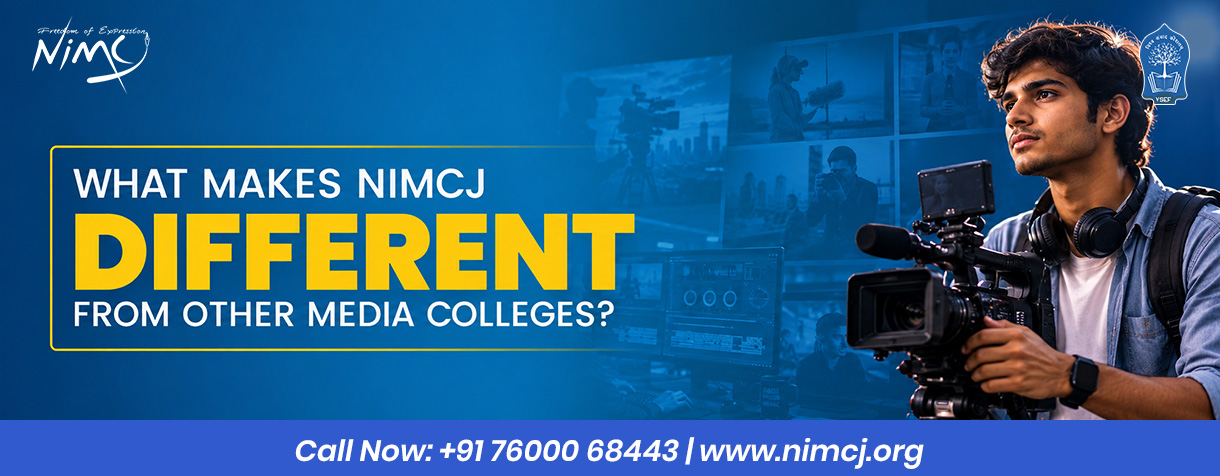
Choosing the right college is an important step for students planning a career in journalism and media. What Makes NIMCJ Different from Other Media Colleges is its focus on combining academic learning with practical media skills.
Students searching for the top media colleges in India often compare courses, infrastructure, faculty, industry exposure, and career opportunities. However, the learning experience can vary significantly between institutions.
NIMCJ, the National Institute of Mass Communication and Journalism, was established in 2007 by Vishwa Samvad Education Foundation. The institute is affiliated with Gujarat University. Its approach combines practical training, professional exposure, and learning across multiple media formats.
This approach is designed to help students understand how media works beyond textbooks.
Choosing between media colleges in India requires more than comparing course names.
Students should consider how much practical experience they will receive during their education. They should also look at the available infrastructure, industry interaction, curriculum, faculty, and opportunities to create media work.
Journalism requires both knowledge and practice.
Students need to understand reporting, media ethics, communication, research, and storytelling. They also need opportunities to apply those concepts. Writing a news report is different from understanding its structure in a textbook. Similarly, learning television journalism is different from presenting a report before a camera.
NIMCJ's approach combines theoretical learning with practical exposure. The institute also highlights experiential learning based on current issues and media trends.
Media professionals can provide perspectives that classroom learning alone cannot offer.
NIMCJ has a guest and visiting mentor programme involving professionals from journalism, filmmaking, media, advertising, and corporate communication.
Such interactions allow students to understand different roles and professional expectations.
One important distinction is NIMCJ's focus on developing skills across different areas of media.
Modern journalists may work with websites, television, radio, podcasts, social media, data, and video. Therefore, understanding only one format may not be enough.
NIMCJ's 25 Pioneer Skills Program is designed around individual media competencies. Each skill area is guided by a specialist with relevant professional experience.
The framework includes journalism, digital media, production, creative communication, and emerging media skills.
This gives students opportunities to explore different areas before choosing their preferred career direction.
Media education has changed with technology.
Traditional journalism remains important. However, digital journalism, podcasts, data journalism, websites, and video platforms have created new opportunities.
NIMCJ's skills framework includes digital journalism, data journalism, podcast production, website design and blogging, radio and television production, cinematography, and investigative journalism.
This multi-format exposure can help students understand the wider media ecosystem.
The 25 Pioneer Skills approach covers different aspects of modern media education.
Strong journalism starts with research and storytelling.
NIMCJ's documented skills include traditional media, investigative journalism, creative writing, anchoring, and travel journalism.
These areas help students develop reporting, research, writing, and presentation abilities.
Digital platforms have created new forms of journalism.
NIMCJ includes digital media, digital journalism, data journalism, website design and blogging, podcast production, and cyber security within its skills framework.
The current BAJMC Hons curriculum also includes areas such as media AI tools, digital media marketing, VFX, cinematography, data analytics, and podcast production.
Media professionals also need production skills.
NIMCJ's documented programme includes television and radio production, cinematography, documentary filmmaking, promotional filmmaking, and sound and music.
Students can therefore explore careers beyond conventional reporting.
Practical experience becomes especially valuable when students create actual media work.
NIMCJ's campus infrastructure includes media labs, digital cameras, editing workstations, and a studio with a three-camera setup. Its facilities also include a radio editing room.
These facilities provide opportunities to practise different production workflows.
Students can work on news presentation, video production, editing, radio, and podcasting.
Digital journalism requires more than writing.
A modern content workflow can involve research, writing, recording, editing, publishing, and audience distribution.
NIMCJ's practical approach includes student work such as podcasts, video reports, campus news productions, and media research projects.
Such work can also contribute to a student's professional portfolio.
The media industry changes quickly.
New platforms emerge, audience behaviour changes, and production tools continue to develop.
Therefore, students benefit from learning from professionals who understand current industry practices.
NIMCJ's guest and visiting faculty programme brings professionals from different areas of media into the learning environment.
These interactions can help students understand newsroom expectations, production challenges, advertising, filmmaking, and communication careers.
The goal is not to replace academic learning.
Instead, professional exposure helps students connect classroom concepts with real media situations.
A journalism and mass communication education can lead to several career paths.
Students can explore roles such as reporters, correspondents, news writers, anchors, producers, sub-editors, and digital journalists.
NIMCJ's published placement information includes alumni working in roles such as reporter, senior correspondent, producer, sub-editor, and reporter-cum-anchor.
Digital media has expanded journalism-related careers.
Students can explore website content, social media, podcasting, video production, data journalism, and digital storytelling.
Media education can also lead outside traditional newsrooms.
Advertising, public relations, corporate communication, content creation, and media production are additional career areas.
Students can therefore choose a path based on their interests and strengths.
Students enter media education at different stages.
NIMCJoffers academic options for students beginning after Class 12 and for graduates seeking postgraduate education.
NIMCJ's BAJMC (Hons.) is a four-year undergraduate programme affiliated with Gujarat University. Students can apply after Class 12 from any stream, according to the institute's admission information.
The programme combines journalism and mass communication with practical media learning.
Students who already hold a bachelor's degree can consider MAJMC.
NIMCJ's MAJMC is a two-year postgraduate programme. Its admission information states that graduates from recognised universities can apply.
This route allows graduates to develop further knowledge in journalism and mass communication.
Searching for the top media colleges in India is a useful starting point. However, students should compare colleges according to their own career goals.
Ask practical questions before choosing a college.
Does the college provide hands-on media training?
Can students work with different media formats?
Are professional mentors involved?
Are studios, cameras, editing facilities, and other media resources available?
Can students create work for their portfolio?
Does the programme include current digital media skills?
Is the degree affiliated with a recognised university?
Does the college provide career and placement support?
These questions can help students make a more informed comparison among journalism colleges in India.
Choosing among media colleges in India is an important decision.
A degree provides academic knowledge. However, a strong media education should also help students develop practical skills and professional confidence.
What Makes NIMCJ Different from Other Media Colleges is its focus on combining academics with practical media education. Its 25 Pioneer Skills framework covers journalism, digital media, production, podcasting, data journalism, filmmaking, and other areas.
For students exploring top journalism colleges in India, the most useful approach is to look beyond the course name.
Look at what you will learn. Look at what you will practise. Look at the professionals you can learn from. Most importantly, consider how your college can prepare you for the changing media industry.
Start Your Media Journey With NIMCJ
If you want to build practical skills for journalism, digital media, television, radio, podcasting, and other media careers, explore the programmes and learning opportunities at NIMCJ.
NIMCJ combines academic learning with practical media training, its 25 Pioneer Skills framework, professional mentorship, specialised media facilities, and exposure to multiple media formats.
Journalism involves reporting, interviewing, writing, presenting, photography, video production, and editing. These skills improve through repeated practice.
NIMCJ currently offers BAJMC (Hons.) at undergraduate level and MAJMC at postgraduate level.
Yes. NIMCJ states that its BAJMC (Hons.) programme is affiliated with Gujarat University.
Graduates can explore journalism, television, radio, digital media, content creation, public relations, advertising, corporate communication, filmmaking, podcasting, production, and media research.
15 Sep 2026
Post by : NIMCJ