
National Institute of Mass Communication & Journalism, Ahmedabad
( Affiliated to Gujarat University )
( Affiliated to Gujarat University )


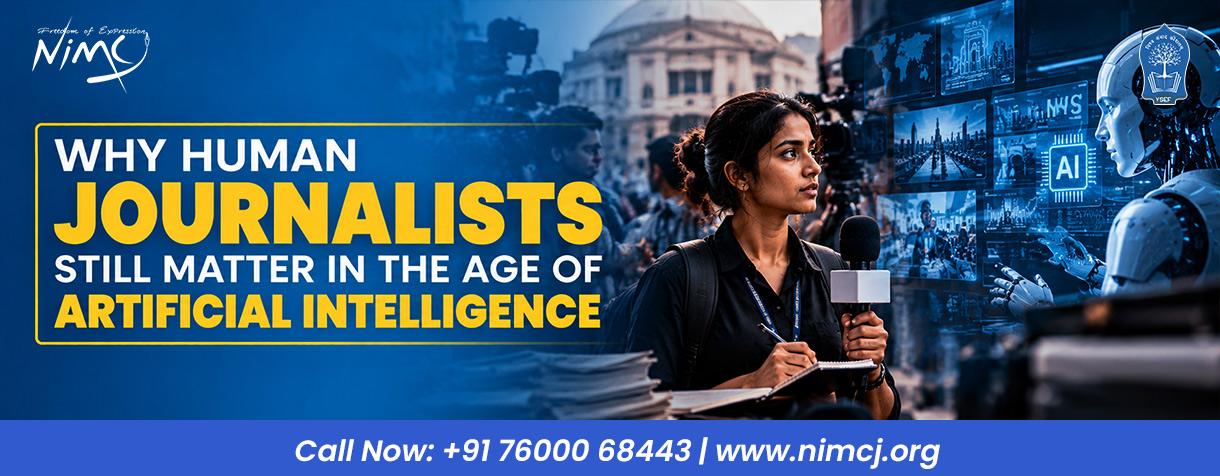
Artificial intelligence is changing how news is researched, produced, edited, and distributed. However, AI in Journalism does not remove the need for skilled reporters. Instead, it is changing what journalists need to do well.
AI can process information quickly. It can summarise documents and suggest headlines. Yet journalism involves much more than producing words.
A journalist must ask difficult questions, verify information, understand people, recognise context, and make responsible decisions. These human abilities remain central to credible journalism.
Artificial intelligence in journalism can support many routine tasks. Journalists may use AI tools to organise information, transcribe interviews, translate material, analyse datasets, or generate early drafts.
These tools can save valuable time. As a result, journalists can spend more time reporting and investigating.
However, using a tool is different from giving it editorial responsibility. A journalist still needs to decide what information matters and what deserves public attention.
For example, AI might identify hundreds of documents connected to a company. A human journalist must determine which documents reveal a meaningful story. They must also contact sources and verify the information.
The technology can assist the process. The journalist provides the purpose.
News rarely exists in isolation. A single statement can have different meanings depending on its social, political, cultural, or historical context.
Human journalists develop this understanding through research and experience. They speak with people, observe situations, and understand local realities.
Consider a report about a community affected by a new government policy. An AI system may accurately summarise the policy. However, a journalist can speak with affected residents and discover how the change actually affects their daily lives.
That context can transform a basic report into meaningful journalism.
This is especially important in India, where language, culture, geography, and social conditions can vary greatly between communities.
One of the strongest reasons human journalists matter is original reporting.
A journalist does not simply repeat information already available online. They find new information.
They may attend a press conference, interview a witness, visit a location, examine documents, contact officials, or develop relationships with confidential sources.
These activities require initiative and human interaction.
For example, imagine a journalist investigating problems at a local public facility. AI may help analyse government documents. However, the journalist must visit the location, speak to residents, ask officials questions, and compare different accounts.
That process creates original reporting.
AI can help journalists work faster. It cannot replace the curiosity and persistence required to discover what others have not reported.
Also Read: Automated Journalism: Threat or Boon for Journalists
Journalism often involves difficult choices.
Should a victim's identity be published? Should an unverified claim be mentioned? Is a photograph necessary? Could publishing certain information put someone at risk?
These decisions require ethical judgment.
Artificial Intelligence in Journalism can identify patterns and generate content. However, journalists remain responsible for understanding the possible consequences of publication.
Human journalists can consider factors such as dignity, privacy, public interest, fairness, and potential harm.
Therefore, journalism education must continue to focus on ethics alongside technology.
A journalist who understands AI but cannot make responsible editorial decisions is not fully prepared for modern newsrooms.
People are at the centre of journalism.
A reporter may interview a family after a disaster, speak with a student facing difficulties, or listen to a whistleblower describing serious concerns.
Good reporting requires more than recording information. It requires listening.
Empathy helps journalists ask better questions and understand experiences without reducing people to statistics.
For example, an unemployment report may include official figures. Yet interviews with workers can reveal the personal impact behind those numbers.
That human perspective makes journalism more meaningful.
This is one reason Human Journalists remain important even as automated content becomes more common.
Speed has always mattered in journalism. However, accuracy matters more.
AI systems can produce convincing information that still requires verification. A journalist must check names, dates, statistics, quotations, documents, and sources before publication.
The journalist also remains accountable for the published story.
If an error appears, a responsible newsroom must investigate it and correct the record. This accountability is an important part of public trust.
For journalism students, this creates an important lesson: technology should strengthen verification rather than weaken it.
AI can support research. The journalist must still ask, How do we know this is true?
Modern audiences receive information from many sources. News competes with social media posts, videos, influencers, search results, and AI-generated content.
As a result, journalism is not only about delivering information. It is also about helping people understand it.
A journalist can explain why a policy matters, compare different viewpoints, identify missing information, and provide relevant background.
For instance, a complicated economic announcement may contain technical figures. A journalist can translate those figures into a clear explanation of how they could affect ordinary households.
This interpretive role becomes even more valuable when audiences face information overload.
The rise of AI means journalism students should not ignore technology. They should learn how to use it responsibly.
At the same time, students should strengthen the skills that make journalists valuable.
Strong reporting requires research, interviewing, fact-checking, critical thinking, writing, media ethics, storytelling, and communication.
Students should also learn data journalism and digital tools. However, technology should support these core abilities rather than replace them.
The strongest future journalists will understand both sides. They will know how AI works and when human judgment must take over.
The future of journalism does not have to be a competition between humans and machines.
A better approach is collaboration.
AI can handle repetitive tasks and help journalists work with large amounts of information. Human journalists can focus on investigation, interviews, analysis, ethical decisions, storytelling, and accountability.
This combination can make journalism more efficient without losing its human purpose.
The key question is not whether AI will become more powerful. It will.
The important question is whether journalists will use that power responsibly.
AI in Journalism is changing the media industry, but it does not change the fundamental purpose of journalism.
Technology can process information quickly. Human journalists give that information meaning.
They investigate, question, verify, listen, empathise, and make difficult decisions. They connect facts with real people and real consequences.
Therefore, journalism students should not see AI only as a threat. They should learn to use it while strengthening the human skills that technology cannot easily replace.
The journalist of the future will not simply compete with AI. The journalist will know how to use AI while remaining responsible for the truth.
NIMCJ prepares aspiring media professionals for the changing world of journalism through practical and industry-focused learning. Its 25 Pioneer Skills include Digital Journalism, Investigative Journalism, Data Journalism, Media Research, Podcasting, Radio and TV Production, and On-the-Job Training.
For students who want to build a career in journalism, the goal is not only to learn new technology. It is to develop the reporting skills, critical thinking, creativity, and professional judgment that make technology useful.
Explore journalism education and prepare for the future of media with National Institute of Mass Communication and Journalism (NIMCJ).
AI can automate some journalism tasks, but it cannot fully replace original reporting, human judgment, empathy, source relationships, and editorial accountability.
Human journalists provide context, verify information, make ethical decisions, conduct interviews, investigate original stories, and remain accountable for published work.
AI can assist with research, transcription, translation, data analysis, summarisation, editing, and other newsroom tasks. Human review remains essential.
Students should develop reporting, interviewing, fact-checking, critical thinking, ethical decision-making, storytelling, digital media, data journalism, and responsible AI skills.
The future is likely to involve greater collaboration between AI tools and journalists. Technology can improve efficiency, while human journalists remain responsible for meaningful and trustworthy reporting.
09 Oct 2026
Post by : NIMCJ