
National Institute of Mass Communication & Journalism, Ahmedabad
( Affiliated to Gujarat University )
( Affiliated to Gujarat University )


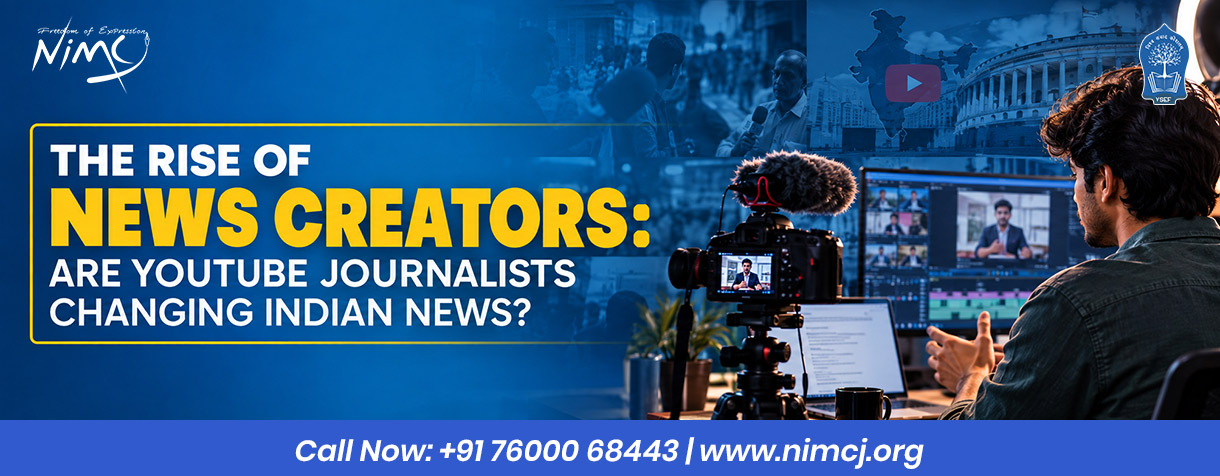
From Classroom to Newsroom no longer means joining a newspaper, television studio, or traditional news agency. Today, journalism students can research stories, record reports, edit videos, and reach audiences through YouTube.
The way Indians consume news is changing rapidly. Around 58% of respondents in India said they use YouTube for news, according to the Reuters Institute's Digital News Report 2026.
This growth has created space for independent news creators and digital-first journalists. They can report stories without depending entirely on traditional broadcast schedules.
YouTube also allows journalists to explain complex issues through video. They can use interviews, graphics, live streams, Shorts, and long-form reports.
Therefore, YouTube is not simply another video platform for journalism. It is becoming an important part of the modern Indian news ecosystem.
For journalism students, this change creates new opportunities. However, it also creates new responsibilities.
News consumption has moved beyond newspapers and television. Smartphones have made video news available almost everywhere.
A viewer can search for Indian news today and find breaking reports, explainers, interviews, live coverage, and analysis within seconds.
YouTube's format also supports different storytelling styles. A journalist can publish a 60-second update or create a 30-minute investigation.
The platform therefore allows creators to serve different audience needs.
The Reuters Institute's 2026 India report identifies YouTube as a major source of news for Indian audiences. It also notes the growing popularity of individual news creators.
This development is significant because YouTube combines news discovery with video storytelling.
Traditional news channels still have television audiences. However, YouTube allows their content to reach viewers who primarily consume news online.
Many established media organizations have therefore expanded their digital video presence. At the same time, independent creators have developed their own audiences.
Video can make complicated subjects easier to understand.
A journalist can show a location, interview an expert, display documents, and explain data within one report.
Short-form videos also help audiences discover stories quickly. Longer videos can then provide additional context.
This creates a news journey that can begin with a YouTube Short and continue with a detailed report.
The modern journalist does not necessarily need to work inside a large newsroom.
A journalism student with strong reporting skills can build a digital news project around a specific subject or community.
From Classroom to Newsroom can now involve learning journalism and digital production together.
A YouTube journalist creates news content specifically for online video audiences. The role can include research, reporting, interviewing, scripting, presenting, filming, editing, publishing, and audience engagement.
However, having a YouTube channel does not automatically make someone a journalist.
Journalism requires responsible reporting. Information should be checked before publication.
Sources should be evaluated carefully. Claims should be supported with evidence. Corrections should be made when errors occur.
This distinction is important as more creators enter the news space.
Traditional journalism often divides responsibilities among reporters, editors, camera operators, producers, and presenters.
A small YouTube news team may combine several of these roles.
One journalist might research a story in the morning. The same person may interview a source, appear on camera, edit the video, and publish it later.
This requires broader skills.
It also gives young journalists greater creative control over their storytelling.
The rise of YouTube news channels is influencing how stories are produced, presented, and distributed.
YouTube itself described a growing shift toward video-first approaches among news organizations in 2026. Its news summit brought together traditional broadcasters and digital-native news organizations around this changing environment.
Digital-first journalism does not have to follow the same structure as television news.
A YouTube journalist can publish when a story is ready. They can also update an earlier video when new information becomes available.
The format encourages experimentation.
For example, one story can become a breaking-news Short, a detailed explainer, an interview, and a live discussion.
This approach allows one reporting effort to serve multiple audience needs.
India has a highly diverse linguistic audience.
Therefore, digital journalism is not limited to English-language content.
Hindi and regional-language YouTube news channels can reach audiences that may prefer consuming news in their own language.
The Reuters Institute has also highlighted creator partnerships and a pilot focused on Hindi and Marathi content.
This creates opportunities for journalists who understand local languages, communities, and issues.
A journalist who can explain the latest Indian news in Hindi or a regional language can serve a highly specific audience.
Traditional media often communicates with audiences through established channels.
YouTube creates a more direct relationship.
Viewers can comment on videos, ask questions, suggest topics, and participate in live streams.
Creators can also understand audience behaviour through analytics.
This feedback can influence future coverage. However, journalists should not allow audience pressure to replace editorial judgment.
A successful news channel needs more than regular uploads.
It needs credible reporting, clear storytelling, good production, and an understanding of its audience.
Research should come before recording.
A journalist should identify reliable sources and verify important claims.
Official documents, government websites, court records, research papers, direct interviews, and credible news reports can help establish facts.
A YouTube news channel should also distinguish between verified information, analysis, and opinion.
Online audiences need clarity.
A good news video should explain the central question early.
The presenter should avoid unnecessary jargon. Visuals should support the story rather than distract from it.
Maps, charts, documents, photographs, interviews, and location footage can make reports more informative.
YouTube journalism also requires digital publishing skills.
The title should accurately describe the story. The thumbnail should attract attention without misleading the viewer.
Relevant keywords can help users discover videos through search.
For example, a channel covering Indian news may use phrases such as "Indian news today," "latest Indian news," "Indian news live," or "latest Indian news in Hindi" when they genuinely match the video's content.
Search optimisation should support accurate reporting. It should not encourage sensational or misleading headlines.
A news channel needs a consistent publishing approach.
The schedule can depend on the channel's resources.
More importantly, viewers should know what type of journalism the channel provides.
Comments and audience questions can also provide useful feedback.
However, journalists should maintain professional standards while interacting with viewers.Starting a news channel is technically easier than starting a traditional newsroom.
However, building a credible news brand requires preparation.
A new creator should first decide what the channel will cover.
The niche could include local news, education, business, technology, entertainment, sports, environment, culture, or community issues.
A focused channel can make its editorial identity clearer.
For example, a student could create a channel focused on Ahmedabad civic issues rather than attempting to cover every story in India.
Create a standard research process before publishing.
Start with the basic questions: What happened? Where did it happen? When did it happen? Who is involved? What evidence is available?
Then identify reliable sources.
If a claim comes from social media, verify it independently before presenting it as news.
A simple workflow can include research, verification, scripting, recording, editing, fact-checking, thumbnail creation, SEO, publishing, and monitoring.
The workflow can become more sophisticated as the channel grows.
Students can begin with basic equipment. A smartphone, microphone, tripod, lighting, and editing software can be enough for many formats.
The quality of reporting matters more than expensive equipment.
Accuracy should remain the foundation of a YouTube news channel.
Creators should avoid publishing unverified claims simply because they are trending.
Sensitive stories require additional care.
Personal information should be handled responsibly. Graphic material should be used only when editorially necessary.
Corrections should be transparent.
These practices help build long-term audience trust.
The rise of YouTube journalism changes the skills students need to develop.
A journalism course can provide the foundation. Students can then combine those skills with digital production.
Also Read: From Classroom to Newsroom: How NIMCJ Makes Students Industry-Ready
Good reporting starts with good questions.
Students should learn how to identify newsworthy information, research backgrounds, conduct interviews, and identify reliable sources.
Interviewing is especially important for YouTube.
A strong interview can become a complete video, a Short, a podcast segment, or social media content.
Mobile journalism has already become an important part of modern reporting.
YouTube adds another dimension to it.
Students should understand framing, lighting, sound, camera movement, video editing, and basic visual storytelling.
They should also learn how to report from locations safely and professionally.
A journalist creating online video should understand search intent.
They should know how audiences search for information.
Keywords can appear naturally in video titles, descriptions, chapters, scripts, and supporting website content.
However, SEO should never compromise accuracy.
The ability to identify misinformation is becoming increasingly important.
A journalist must question viral claims rather than simply repeat them.
Reverse image searches, source comparison, official records, timestamps, location verification, and direct communication with relevant sources can help.
YouTube analytics can show how viewers discover and watch content.
Journalists can learn which topics attract viewers and where audiences stop watching.
Analytics can improve presentation and distribution.
However, numbers should not become the only measure of editorial value.
A story can be important even when it does not immediately generate millions of views.
YouTube news and traditional news channels share the basic responsibility of informing audiences.
Their distribution models are different.
Television news generally works through scheduled programming and established broadcast infrastructure.
YouTube allows content to remain available for search and on-demand viewing.
A television bulletin might cover several stories in a fixed time slot.
A YouTube channel can create separate videos for individual stories.
The two formats are also increasingly overlapping.
Traditional Indian news channels are using YouTube to expand their digital audiences. Meanwhile, independent creators are adopting professional reporting techniques.
Therefore, the future may involve greater collaboration between traditional newsrooms and independent creators rather than a simple replacement of one by another.
Also Read: Why Digital Journalism Is Overpowering Traditional Journalism
The creator-led news environment provides opportunities. It also introduces serious challenges.
Breaking news creates pressure to publish quickly.
However, speed can increase the risk of mistakes.
A responsible journalist should confirm important information before publishing.
Being slightly later but accurate can protect a channel's credibility.
Social media can provide useful leads.
It can also spread false information rapidly.
A viral video is not automatically evidence of a current event.
Journalists should verify its source, date, location, context, and authenticity.
Artificial intelligence is adding another challenge.
AI can help journalists with research, transcription, translation, editing, and other production tasks.
At the same time, synthetic images, videos, and audio can make verification more difficult.
YouTube introduced more prominent AI disclosure labels in 2026 and expanded likeness detection to a pilot group that included journalists and other public figures.
India is also investing in AI skills for media professionals. The Ministry of Information and Broadcasting announced a national AI skilling initiative with Google and YouTube to train 15,000 creators and media professionals.
For journalism students, this means AI literacy is becoming a useful professional skill.
Trust is one of the biggest challenges for digital news.
A creator may have a large following. However, popularity does not automatically establish journalistic credibility.
Trust develops through consistent reporting.
Transparent sourcing, corrections, balanced context, and responsible presentation can help build that trust.
YouTube journalists are changing the news environment, but that does not mean traditional journalism is disappearing.
Instead, journalism is becoming more distributed across platforms.
A reporter may work for a television network and maintain a YouTube presence.
A newspaper may publish articles alongside video explainers.
An independent creator may build a digital newsroom around a particular subject.
The important question is therefore not whether YouTube will replace traditional journalism.
The more useful question is how journalists can maintain professional standards while adapting to new platforms.
For journalism students, this shift creates a broader career landscape.
The future of Indian news will likely involve more video, more creator-led formats, and greater integration between journalism and digital platforms.
YouTube reported in 2026 that creators are increasingly building media businesses and using new AI-assisted tools across the production process.
The Indian government has also introduced initiatives involving creators, digital broadcasting, and AI skills.
These developments point toward a media environment where journalists need both editorial and digital skills.
For students, that means journalism education should not stop with writing a news report.
Future journalists may need to research, report, present, shoot, edit, optimise, verify, and analyse audience behaviour.
From Classroom to Newsroom can therefore become a practical digital journey.
The platform may change.
The technology may change.
The responsibility of journalism remains the same: inform audiences accurately, responsibly, and meaningfully.
The rise of YouTube news creators is changing how Indians discover and consume information.
The growth of YouTube journalism creates new opportunities for aspiring reporters. Students no longer have to think only about newspapers, television studios, or traditional newsrooms.
They can learn reporting and build digital storytelling skills at the same time.
However, becoming a successful YouTube journalist requires more than gaining subscribers.
It requires curiosity, accuracy, research, communication, technology skills, and professional ethics.
For today's journalism students, the path From Classroom to Newsroom can include a camera, a microphone, a smartphone, and a YouTube channel.
But the most important tool remains responsible journalism.
At NIMCJ, students get practical exposure to YouTube journalism, live podcasting, news presentation, and digital storytelling. Take your first step From Classroom to Newsroom and build the skills needed for today’s evolving media industry.
Start your media journey with NIMCJ. Explore our programs and shape your future in journalism.
A YouTube journalist creates and publishes news reports, interviews, explainers, investigations, or other journalism-focused video content on YouTube. The role can involve research, reporting, interviewing, presenting, filming, editing, and publishing.
Start by selecting a clear news niche and target audience. Build a reliable research and fact-checking process. Then create a YouTube channel, develop a production workflow, publish consistently, and use accurate titles and descriptions.
YouTube provides a large audience for video-based journalism. Reuters Institute reported that around 58% of respondents in India use YouTube for news.
However, journalists must maintain accuracy, transparency, and ethical reporting standards.
Important skills include reporting, interviewing, research, fact-checking, scriptwriting, video production, editing, presentation, YouTube SEO, digital storytelling, and audience analytics.
Journalists should compare multiple reliable sources, check official records, verify images and videos, contact relevant sources, check dates and locations, and clearly separate confirmed facts from unverified claims.
01 Sep 2026
Post by : NIMCJ