
National Institute of Mass Communication & Journalism, Ahmedabad
( Affiliated to Gujarat University )
( Affiliated to Gujarat University )


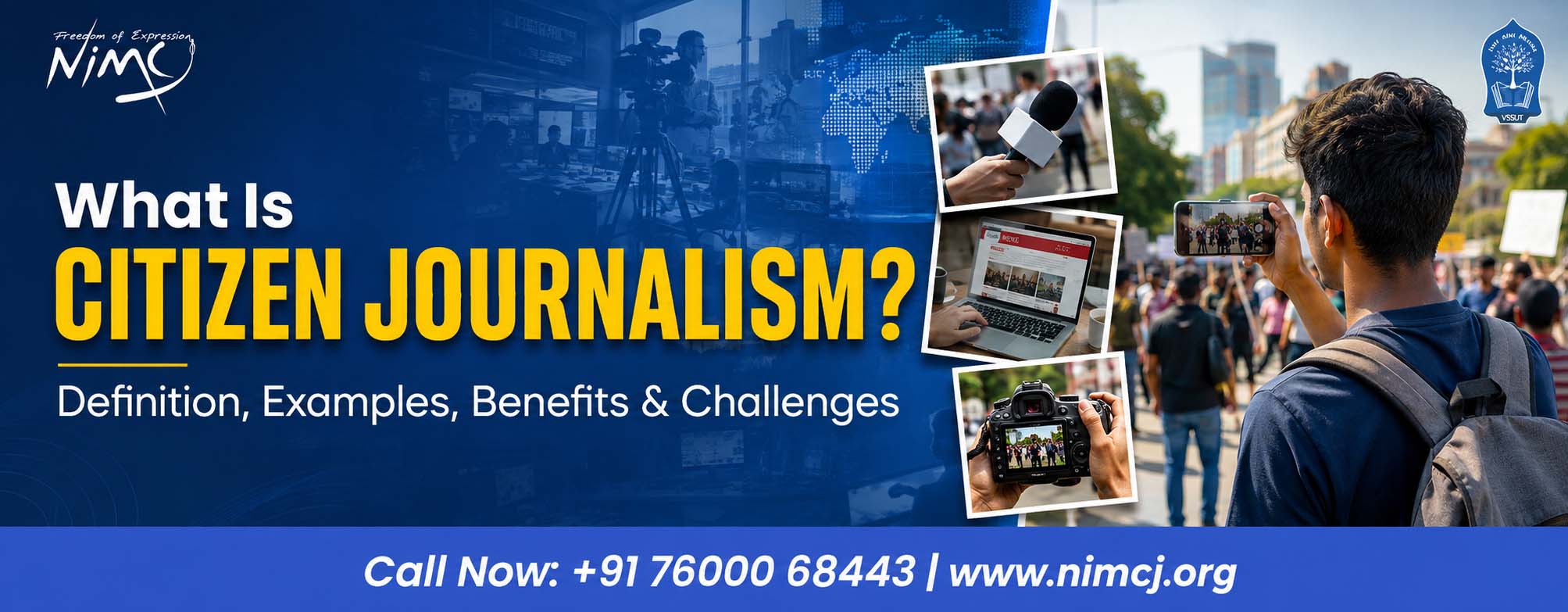
What Is Citizen Journalism? In simple terms, it means ordinary people gather, report, and share news without any formal journalism training. They use smartphones, blogs, and social media to cover events as they happen. Today, citizen journalism sits alongside professional reporting, and it often reaches stories that mainstream media misses.
This guide explains the concept in detail. You will also find real citizen journalism examples, its growing role in India, its key benefits, and the challenges it brings. Whether you are a student exploring a career in media or simply curious, this article covers everything you need to know.
Citizen journalism refers to the practice of non-professionals collecting, producing, and distributing news content. These reporters are not employed by newspapers, TV channels, or online news portals. However, they use accessible tools like phone cameras and social media apps to document events happening around them.
Their reports often cover accidents, protests, natural calamities, or local civic issues. Because they are already present when a story breaks, they capture moments that no camera crew could reach in time. Media scholars sometimes call this practice participatory journalism or grassroots reporting.
Both terms describe the same shift. Journalism is moving from a closed profession into an open activity that any citizen can join, one smartphone at a time.
Traditional journalism follows a structured process. Editors assign stories, reporters verify facts through multiple sources, and publications follow strict editorial standards before a story goes live. This process takes time, but it builds accuracy and trust.
Citizen journalism, in contrast, skips most of this structure. A person simply records what they see and posts it online instantly. This makes citizen reports much faster, but also less filtered and harder to verify.
Therefore, audiences often see raw, unedited footage long before professional journalists even reach the location. However, both forms of journalism ultimately serve the same larger goal: keeping the public informed.
Citizen journalism is not a new phenomenon. It existed long before smartphones became common. In fact, ordinary people captured historic events even during the analog era, using simple cameras and camcorders.
The 2004 Indian Ocean tsunami marked a major turning point. Tourists and survivors uploaded raw footage online before television crews could arrive at the coast. This event showed the world how powerful real-time citizen reporting could be.
Later, the rise of blogging platforms, followed by Twitter and YouTube, gave citizen journalists global reach. As a result, anyone with an internet connection could publish news instantly, without waiting for a newsroom's approval.
Citizen journalism appears in many formats today. Some reporters share short video clips filmed on their phones. Others write blog posts or detailed social media threads explaining an issue step by step.
Podcasts and voice notes have also become popular, especially in regions with lower literacy rates. Photography remains one of the oldest and most powerful formats too. A single striking image can spread faster than a full written article.
Also Read: How to Start a Podcast: Step-by-Step Guide for Beginners
Social media platforms such as X, Instagram, YouTube, and Facebook remain the most common spaces for citizen reporting. WhatsApp groups also play a major role in India, especially for sharing hyperlocal news within neighbourhoods and villages.
Additionally, dedicated citizen journalism platforms exist today. These platforms train contributors and verify submissions before publishing. Such structured platforms add credibility to citizen-led reports and reduce the risk of misinformation.
Several major world events highlight the power of citizen journalism. During the 2009 Iranian election protests, citizens used Twitter to share live updates after foreign journalists faced strict reporting restrictions. The world followed the unfolding crisis largely through their eyes.
Similarly, during the Arab Spring uprisings, ordinary citizens documented protests and government crackdowns on their phones. Their videos reached global audiences within minutes, long before international news teams could enter these regions.
India has built its own strong citizen journalism movement over the past two decades. Grassroots platforms here have empowered rural and marginalised voices long before social media became mainstream. The next section explores these examples in detail.
CGNet Swara, launched in Chhattisgarh, lets villagers report local issues through a simple phone call. Callers record their concerns using an interactive voice system, and trained journalists verify and publish these reports online.
This model has exposed corruption, poor infrastructure, and administrative negligence in some of India's most remote tribal areas, places where mainstream reporters rarely travel.
Khabar Lahariya offers another remarkable example. Rural women from marginalised communities produce this newspaper across Uttar Pradesh. It began in Chitrakoot in 2002 and has since grown into a multilingual digital newsroom reaching a much wider audience.
These platforms prove that citizen journalism in India often addresses gaps that mainstream media overlooks, particularly across rural and underserved regions of the country.
Social media has amplified citizen journalism across Indian cities too. During floods, road accidents, or civic emergencies, local residents often post updates before official news channels even respond.
Municipal bodies and police departments increasingly monitor these posts for real-time information. As a result, citizen reporting now genuinely influences how authorities respond during emergencies.
Also Read:Citizen Journalism and Its Top 3 Advantages
Citizen journalists are often present before professional crews arrive at a scene. Consequently, breaking news spreads within minutes instead of hours. This speed helps both authorities and the public respond quickly during emergencies.
Many rural and marginalised communities rarely appear in mainstream coverage. Citizen journalism gives them a direct platform. Stories about local corruption, gender issues, or neglected infrastructure finally reach much wider audiences.
Newsrooms cannot send reporters everywhere at once. Citizen contributions fill this gap without added cost. This is especially useful for hyperlocal stories that traditional media often skips due to limited budgets.
When citizens document wrongdoing, officials face public pressure to act. Several corruption cases in India were resolved only after public exposure through citizen platforms. Citizen journalism, therefore, strengthens democratic accountability at the grassroots level.
Citizen reports often lack editorial checks. As a result, misinformation can spread quickly, especially during emergencies or politically sensitive events. Audiences must verify facts before sharing citizen-generated content further.
Citizen journalists rarely receive formal training in media ethics or privacy law. Consequently, they may unintentionally violate someone's privacy or publish unverified claims. This raises real legal risks for both the reporter and the hosting platform.
Unlike professional journalists, citizen reporters usually lack institutional protection or legal backing. Covering protests, conflicts, or local corruption can expose them to genuine danger. Some citizen journalists in India have faced threats for exposing wrongdoing in their own communities.
Aspiring journalists can learn a great deal from citizen journalism. Skills like storytelling, quick fact-checking, and clear communication remain essential in both fields. However, formal training adds structure that citizen journalism often lacks.
Students who wish to build a serious journalism career should also learn media law, ethics, and editorial standards. A structured journalism course helps students combine natural curiosity with professional discipline, preparing them for real newsroom demands.
Citizen journalism and professional journalism are not competitors. Instead, they complement each other in meaningful ways. Citizens often break a story first, while professional journalists verify, investigate, and add depth to it.
Many mainstream outlets now actively use citizen footage, crediting the original source whenever possible. This partnership improves both the reach and the accuracy of overall news coverage for everyone involved.
Citizen journalism will likely keep growing as smartphone and internet access expands further, especially across smaller towns and rural regions. Artificial intelligence tools may soon help verify citizen reports faster and flag misinformation early.
Media literacy programmes will also become more important. These programmes can teach citizens how to report responsibly and ethically. As these tools mature, citizen journalism could become an even more trusted part of the wider news ecosystem.
Citizen journalism shows that anyone can report. However, professional journalism training shows you how to report with accuracy, ethics, and impact.
At NIMCJ (National Institute of Mass Communication and Journalism), Ahmedabad, you learn exactly that. From Investigative Journalism and Media Ethics to Digital Journalism and Data Reporting, NIMCJ's expert-led curriculum builds the skills that separate credible journalists from the crowd.
NIMCJ is ranked among India's top mass communication institutes by India Today, Outlook Magazine, and OPEN Magazine for five consecutive years. BAJMC (Hons) and MAJMC Admissions for 2026-2027 are now open.
To summarise, citizen journalism has reshaped how the world receives news. It fills coverage gaps, amplifies unheard voices, and speeds up breaking news reporting in ways traditional newsrooms cannot always match.
However, it also brings real challenges around accuracy, ethics, and reporter safety. Understanding both sides helps aspiring journalists appreciate exactly where citizen reporting fits within today's larger media landscape.
Citizen journalism means ordinary people, not professional reporters, gather and share news using tools like smartphones and social media platforms.
Examples include public coverage of the 2009 Iranian election protests on Twitter, Arab Spring documentation, and India's CGNet Swara and Khabar Lahariya platforms.
In India, citizen journalism is known for amplifying rural and marginalised voices through grassroots platforms like CGNet Swara and Khabar Lahariya.
Citizen journalism can be reliable, but it needs verification. Unlike professional journalism, it often lacks editorial checks before content gets published.
Yes. Many citizen journalists later pursue formal journalism education to strengthen their skills and build a long-term professional media career.
BAJMC (Hons) and MAJMC Admissions for 2026-2027 are now open. Call Now: 7600068443
Your Next Step Starts Here: Inquiry Now
10 Aug 2026
Post by : NIMCJ