
National Institute of Mass Communication & Journalism, Ahmedabad
( Affiliated to Gujarat University )
( Affiliated to Gujarat University )


There is a news report. And then there is a feature story.
A news report tells you that a farmer in Vidarbha took his own life. A feature story takes you to his house. It shows you the cracked soil, the empty silo, the framed photograph of better days on the mud wall, and the wife who still carries a printout of a loan waiver scheme she never got to use.
One informs you. The other makes you feel.
Feature writing is where journalism becomes literature. It is where facts are dressed in humanity, where data finds its soul, and where readers stop scrolling and start reading - really reading.
For students of mass communication, journalism, and media studies, feature writing is one of the most powerful and sought-after skills you can develop. It is the backbone of long-form journalism, magazine writing, digital storytelling, and even broadcast documentaries.
In this guide, we walk you through everything you need to know about how to write a feature story - from finding ideas and doing research, to structuring your story, nailing the lead, and finishing with a kicker that stays with the reader long after they have put the paper down.
A feature story is a detailed, in-depth piece of writing that goes beyond the basic facts of a news event to explore its background, context, human impact, and significance. Unlike a straight news report, a feature story is not bound by the strict inverted pyramid structure. It has more creative freedom in language, structure, and storytelling technique.
Definition: A feature story is a non-fiction article that combines factual reporting with narrative storytelling techniques to inform, entertain, inspire, or emotionally engage the reader on a topic of human interest, social relevance, or cultural significance.
Feature stories are the kind of articles that make people miss their bus stops. They appear in the weekend editions of newspapers, in magazines like India Today, Outlook, and The Week, on platforms like The Wire, Scroll.in, and The Print, and in digital long-form formats like Medium and Substack.
At its heart, a good feature story answers not just the what, but the why and the how - and most importantly, it makes the reader care.
One of the first things journalism students must understand is how a feature story is different from a news story. Both are forms of journalism, but they serve very different purposes and follow different rules.
If a news story is a photograph, a feature story is a painting. It takes the same subject and adds layers, colour, texture, and meaning.
Feature stories come in many forms. Knowing the different types helps you choose the right approach for the story you want to tell. Here are eight important types of feature stories every journalism student should know.
This is the most common and emotionally powerful type of feature. It focuses on a real person or group of people and tells their story in a way that makes readers empathise, laugh, cry, or reflect. The subject does not need to be famous. The story just needs to be deeply human.
Indian Example: A feature on a daily-wage labourer in Surat who sends his daughter to an IIT coaching class from his savings of Rs. 500 a month.
A profile feature is an in-depth portrait of a person - their personality, achievements, struggles, and what makes them interesting or important. The subject can be a celebrity, a politician, a local hero, or an ordinary person with an extraordinary story.
Indian Example: A profile of a first-generation woman journalist from a tribal village in Jharkhand who now reports for a national news channel.
A trend feature identifies and explores a pattern that is emerging in society, culture, economy, or technology. It uses data, expert opinion, and real-life examples to show readers something that is happening around them that they may not have noticed.
Indian Example: How Gen-Z journalists in India are abandoning traditional newsrooms to become independent reporters on YouTube and Instagram.
A how-to feature provides readers with practical, actionable information on how to do or achieve something. It is educational, clear, and reader-centred. It is common in lifestyle, health, finance, and career journalism.
Indian Example: How to apply for the PM UDAY scheme: a step-by-step guide for small traders in Gujarat.
An investigative feature goes deep into an issue, exposing wrongdoing, uncovering hidden truths, or challenging official narratives. It requires extensive research, multiple sources, documents, and sometimes months of reporting.
Indian Example: How private coaching institutes in Kota manipulate student success data to attract more enrolments.
A colour feature immerses the reader in a place, event, or atmosphere through rich sensory description. It is journalism written with the eye of a photographer and the pen of a novelist. It is common in travel writing and coverage of festivals, sports events, or cultural gatherings.
Indian Example: Inside the chaos and colour of the Pushkar Camel Fair: a first-person account from the dust and devotion of Rajasthan.
A travel feature takes the reader on a journey - to a place, its people, its food, and its stories. It is more than a travel diary. A good travel feature has a strong narrative thread and captures the cultural and human soul of a place.
Indian Example: A weekend in Kutch: how the world's largest salt desert is becoming India's most unexpected arts destination.
This type takes readers behind the curtain - inside an institution, a process, or a world they would otherwise never see. It reveals the hidden workings of something familiar and gives readers a fresh perspective.
Indian Example: What really happens in the 12 hours before a national newspaper goes to print - a behind-the-scenes look at the newsroom of Gujarat Samachar.
What separates an average feature story from a great one? Here are seven defining characteristics that every journalism student must understand.
The best feature stories feel inevitable - as if there was no other way to tell them. That feeling comes from a writer who has done their homework, found the right people, and cared deeply about the subject.
Every great feature starts as a question - usually a question that someone else forgot to ask. Finding good feature ideas is a skill that develops with practice and curiosity. Here are eight ways to find compelling feature story ideas.
The best feature stories are hiding in plain sight. A chai vendor who has been sitting at the same corner for 30 years. A school in a flood-prone village that has not received textbooks in three years. Pay attention. Ask questions. Be curious about things others walk past.
Government reports, NCRB data, census records, RBI bulletins, and NGO surveys are goldmines of feature ideas. A statistic buried in a report is a feature story waiting to happen. Behind every number is a human story.
Trending topics, viral posts, and community groups all surface real issues. But the feature writer's job is to go deeper than the tweet - to find the person, the place, and the full story behind the noise.
The biggest stories come from people who are rarely interviewed: domestic workers, farmers, first-generation students, migrants, street vendors, and traditional artisans. Go where mainstream media does not go.
Stories tied to seasons, festivals, anniversaries, or national days have a natural news peg. The best features use the occasion as a door into a deeper story, not just a surface-level celebration piece.
What happened to the flood victims from two years ago? Where is the farmer whose photo went viral? Follow-up features are often the most powerful - and the most neglected.
University professors, doctors, scientists, and social workers often hold fascinating unpublished research or observations. A short conversation with the right expert can unlock a powerful story idea.
For journalism students at NIMCJ and across India, your own campus and city are underreported. Your classmates have incredible stories. Your neighbourhood has layers that no national journalist has ever explored. Start local. Start real.
A feature story is only as good as the reporting behind it. Unlike a quick news update, a feature demands thorough, multi-layered research.
Step 1: Do your background research first. Before you approach a single source, know your subject inside out. Read everything that has been published on the topic. Study the data, the history, the key players. Use Google Scholar, newspaper archives, government databases like data.gov.in, RTI filings, and library resources.
Step 2: Identify the right sources. Good feature reporting requires multiple types of sources. You typically need a protagonist at the centre of your story, expert sources who can provide context, opposing voices who see the issue differently, documentary sources like government orders and court judgements, and on-ground witnesses who have seen the reality first-hand.
Step 3: Conduct meaningful interviews. The interview is the heart of feature reporting. Do not read from a rigid list of questions. Have a conversation and let the story unfold naturally. Ask open-ended questions. Listen actively. Ask for specific examples. Always cross-check what your sources tell you with documents and other sources.
PRO TIP
The Golden Rule of Feature Interviews: Never ask a question that can be answered with just 'Yes' or 'No'. Ask 'Why', 'How', 'What does that feel like', and 'Can you tell me more about that moment?'
Step 4: Observe and describe. Feature writers are not just recorders of speech. They are observers of the world. When you visit a location for a story, slow down. Notice the details. What does the place smell like? What sounds fill the room? How does the light fall? These details do more work than three paragraphs of explanation.
Step 5: Organise your notes. After reporting, organise your notes into themes, not just a chronological transcript. Identify the best quotes. Mark the scenes with the most detail. Note the moments of surprise, conflict, or revelation. These are the building blocks of your feature.
A well-written feature story has six key elements.
Think of your feature story like a good Hindi film: a gripping opening scene, a solid story with layers, and an ending that stays with the audience after the credits roll.
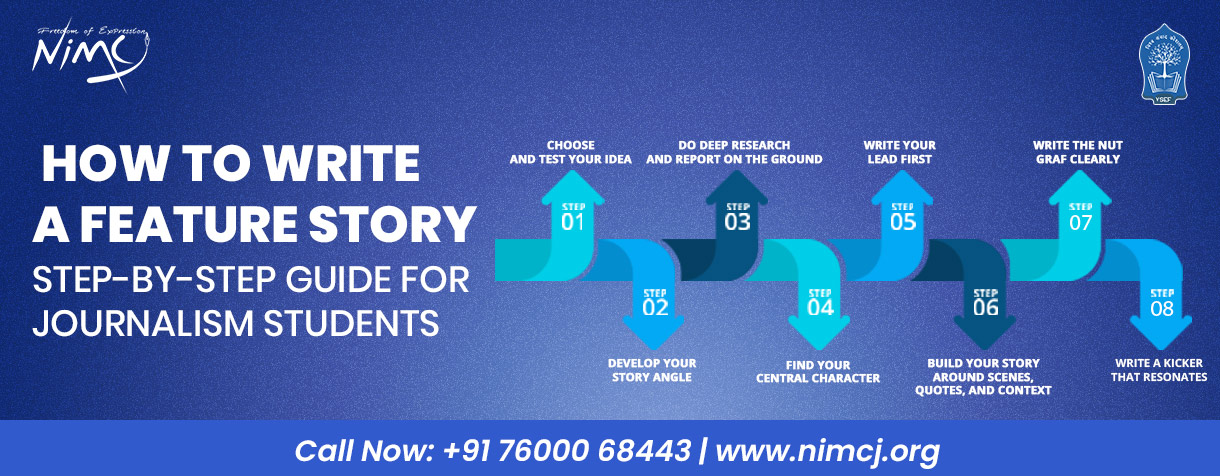
Now that you understand the elements, here is the complete step-by-step process of writing a feature story.
Step 1: Choose and test your idea. Ask yourself three questions before committing to a story. Is there a real human story here, not just a topic? Can I find sources willing to talk? Does this story matter to my target audience? If yes to all three, proceed.
Example: The topic of mental health among students is too broad. But a story about why three students at a Surat engineering college found help in an unlikely group therapy session run by a chai-stall owner - that is a feature.
Step 2: Develop your story angle. The angle is your specific lens on a broader topic. It answers what aspect of this topic you are exploring, and for whom. A sharply defined angle makes reporting more focused and the final story more powerful.
Example: Not the problem of water shortage in Ahmedabad, but how women in a Chandkheda neighbourhood walk three kilometres every morning at 4 AM because the municipal tap runs for only 20 minutes a day.
Step 3: Do deep research and report on the ground. Spend time with your subject. Read the documents. Conduct interviews. Visit the locations. The depth of your reporting directly determines the quality of your writing. The story lives in the field, not in the press release.
Step 4: Find your central character. Great features are usually told through the eyes of one central person - the protagonist. This person becomes the emotional anchor of the story. All the larger themes, data, and expert opinions are woven around their lived experience.
Example: For a story on the impact of GST on small traders, find one Ahmedabad shop owner whose business tells the full story - not as a statistic, but as a person.
Step 5: Write your lead first. The lead is the hardest and most important paragraph you will write. Try multiple versions before settling on one. The lead should drop the reader into a moment, a scene, a conflict, or a question. It should make continuing to read feel like a compulsion, not a choice.
Example: Bad lead - Every year, thousands of craftspersons in Gujarat lose their livelihoods due to industrialisation. Good lead - Ramjibhai's hands have made one thousand saris. He cannot afford to buy one.
Step 6: Build your story around scenes, quotes, and context. The body of a feature moves in a rhythm: scene, then quote, then context, then scene again. Scenes show the reader. Quotes give the characters a voice. Context explains the wider significance. When you break this rhythm with too many dry explanatory paragraphs, the reader loses interest.
Step 7: Write the nut graf clearly. The nut graf is the paragraph - usually the second or third - that tells the reader what the feature is really about and why they should care. A weak nut graf leaves readers confused. A strong one locks them in. Place it no later than the third paragraph.
Step 8: Write a kicker that resonates. Never end a feature story with a summary. The kicker should feel like the last frame of a great film. Use a final scene, a powerful closing quote, a full-circle callback to the opening, or a thought that lingers. Give the reader something to carry away.
Example kicker: As the afternoon light fades, Salvi holds up a finished panel - six months of work compressed into two feet of iridescent silk. He says nothing. He doesn't have to.
The lead is your story's first impression. You have about three seconds to convince a reader to stay. Here are five effective types of feature leads with examples from Indian journalism contexts.
Begins with a short, specific story or moment that draws the reader in and illustrates the bigger theme. This is the most widely used and most effective feature lead. It feels human, immediate, and real.
Example: On the morning she was supposed to sit for her Class 12 board exam, 17-year-old Priya Chauhan was on a bus to Surat - not to write the exam, but to look for work after her father's stroke. She hasn't opened a textbook since. (Lead for a feature on the dropout crisis among girls in semi-urban Rajasthan.)
Paints a picture and puts the reader inside a place or moment through rich sensory detail. Ideal for colour features, travel writing, and human interest stories where atmosphere is central.
Example: The smell hits you before the sight does - diesel, fish, and something else you cannot name. By 4 AM, the Matunga fish market is already at full roar, a thousand voices negotiating in five languages under fluorescent light. (Lead for a feature on Mumbai's disappearing traditional markets.)
Opens with a character speaking - a line of dialogue that immediately establishes voice, conflict, or tension. It feels cinematic and pulls readers in through a character's voice rather than a writer's description.
Example: "You want to know how I survived? I ate rice with salt for eleven days." Mohammed Rafiq, 56, says this without drama, pouring tea in a plastic cup in his one-room home in Dharavi. (Lead for a feature on informal-economy workers post-COVID.)
Opens with a provocative question that the story then answers. Use this lead carefully. The best question leads pose something genuinely puzzling or counterintuitive, not something obvious.
Example: What do you do when the doctor who is supposed to save your life is 400 kilometres away? (Lead for a feature on the specialist doctor shortage in tribal districts of Chhattisgarh.)
Opens with a sharp juxtaposition - two things that should not go together, or a fact that defies expectation. It creates immediate intrigue by presenting a contradiction or irony.
Example: India produces more engineers every year than the United States and China combined. And yet, at a construction site in Navi Mumbai, a man with a BE degree from a private university in Pune is mixing cement for Rs. 400 a day. (Lead for a feature on the engineering graduate unemployment crisis.)
The Lead Test: Read your opening paragraph out loud. If you would keep reading, it works. If your attention wanders, rewrite it.
Here is a short illustrative feature story with each element labelled. Study this carefully - it shows you how all the principles we have covered come together in an actual piece of writing.
Story: The Last Weaver of Patan - a human interest feature about a dying traditional craft in Gujarat.
Headline: The Last Weaver of Patan
Why it works: Catchy, specific, evokes curiosity.
Deck or Subheadline: How 82-year-old Ramjibhai Salvi is keeping the dying art of Patola silk weaving alive - one thread at a time.
Why it works: Expands on the headline and adds context.
Lead (Hook): His fingers move with the certainty of a man who has done this ten thousand times. Ramjibhai Salvi, 82, bends over a wooden loom that is older than most of his grandchildren, pulling threads of pure silk into a pattern that no machine can replicate.
Why it works: Descriptive lead - drops the reader into the scene immediately.
Nut Graf: Salvi is one of fewer than twelve master weavers left in Patan who know the ancient art of double ikat Patola - a UNESCO-recognised craft that once dressed royalty across India and Southeast Asia. Today, that knowledge risks disappearing forever.
Why it works: Explains why this story matters and raises the stakes.
Body with Quote: "I have been weaving since I was nine," he says, without looking up. "My father taught me. His father taught him. But my son drives an auto-rickshaw." The sentence lands like a dropped stitch.
Why it works: A powerful quote that advances the narrative and reveals character.
Transition: Across Patan, the story is the same. The younger generation has moved to Ahmedabad, to call centres and construction sites, leaving behind looms that gather dust in ancestral homes.
Why it works: Connects the individual story to a larger social trend.
Kicker (Ending): As the afternoon light fades, Salvi holds up a finished panel - six months of work compressed into two feet of iridescent silk. He says nothing. He doesn't have to.
Why it works: Ends with a scene, not a summary. Leaves an emotional impression.
Notice how this story never explains Patola weaving in a dry, encyclopaedic way. Instead, it shows you the craft through the hands, voice, and life of one man. That is the feature writer's fundamental technique: show, don't just tell.
Also Read: Common Mistakes in Feature Writing and How Students Can Avoid Them
"The good writer of prose must be part journalist, part educator, part humorist, part social critic, part visual artist — and above all, a storyteller." — William Zinsser, On Writing Well
A feature story is a long-form, in-depth piece of journalism that goes beyond basic news reporting to explore the human, social, or cultural dimensions of a topic. Unlike a news report, it is not bound by the inverted pyramid structure and uses narrative, descriptive, and storytelling techniques to engage the reader. Feature stories appear in newspapers, magazines, and digital publications.
A news story reports recent facts in a direct, time-sensitive format using the inverted pyramid structure. A feature story explores a topic in depth, with narrative structure, rich description, and human interest. News stories are typically shorter at 300 to 600 words. Features are longer at 800 to 3,000 words or more. A news story tells you what happened. A feature explores why it matters and how it affects people.
The main types of feature stories are human interest features, profile or personality features, trend features, how-to or service features, investigative features, colour or descriptive features, travel features, and behind-the-scenes features. Each type has its own focus, tone, and structure, but all share the core feature writing principles of narrative depth, human characters, and reader engagement.
The nut graf is the paragraph - usually appearing second or third in a feature story - that explains what the story is really about and why it matters. It is the feature writer's thesis statement. A strong nut graf tells readers: this is what you are reading about, and this is why you should care. Without a clear nut graf, readers lose their bearings in the story.
The kicker is the final paragraph or line of a feature story. It is designed to leave a lasting impression on the reader - a sense of emotional resonance, a thought-provoking reflection, or a powerful closing image. A good kicker never summarises the story. Instead, it ends with a scene, a revealing quote, or a callback to the opening that gives the reader something to think about after they finish reading.
Feature stories vary widely in length depending on the publication and the scope of the story. A typical newspaper feature is 800 to 1,200 words. A magazine feature is usually 1,500 to 3,000 words. Long-form investigative features can be 5,000 to 10,000 words or more. For journalism students, a well-structured 1,000 to 1,500 word feature is a good target for practice.
A good feature story lead immediately captures the reader's attention by dropping them into a scene, a character, a conflict, or an unexpected fact. The five most effective types of feature leads are anecdotal, descriptive or scene-setting, narrative or dialogue, question, and contrast or surprise. The best leads are specific, human, and immediate - never abstract or generic.
Feature story ideas can be found by paying attention to everyday life and the people around you, following government reports and data, monitoring social media trends, talking to people on the margins of society, using seasonal or calendar pegs, revisiting old news stories, consulting experts and academics, and exploring your own campus and city. The key is to ask questions that others have not thought to ask.
The most common feature writing mistakes are a weak or generic lead, burying the nut graf too deep in the story, including too many facts and too little narrative, using vague or unusable quotes, ending with a summary instead of a kicker, and relying only on official sources instead of on-the-ground voices. Recognising these mistakes is the first step to producing stronger feature stories.
Absolutely. Feature writing is one of the most versatile and highly valued skills in mass communication. It is the foundation of magazine journalism, long-form digital storytelling, broadcast documentary scripting, brand content writing, PR writing, and social media storytelling. Students who master feature writing develop stronger critical thinking, narrative skills, and empathy - qualities that are valuable across every media career.
Feature writing is more than a journalism skill. It is a way of paying attention to the world. It is the discipline of looking closely at what others walk past, of listening to voices that rarely get heard, and of translating human experience into words that inform, move, and endure.
The process outlined in this guide - from finding your idea and doing your reporting, to writing your lead, building your story, and landing your kicker - is not a rigid formula. It is a framework that you will adapt, stretch, and make your own as you develop your writer's voice.
The best feature stories ever written in Indian journalism - P. Sainath's work on rural poverty, Neha Dixit's investigations into tribal rights, the long-form storytelling of Caravan magazine - all share one quality: they were written by journalists who cared deeply about their subjects and were willing to spend the time to do them justice.
Start with a story that matters to you. Find the person at its centre. Report with patience and curiosity. Write with honesty and care. That is how great feature stories are born.
At NIMCJ, the National Institute of Mass Communication and Journalism in Ahmedabad, feature writing is not just a subject on a syllabus. It is a living practice, taught through real assignments, field reporting, and mentorship from working journalists. Whether you want to write for newspapers, magazines, digital platforms, or broadcast media - the skill of the feature writer will serve you throughout your career.
Join Gujarat's leading mass communication institute. At NIMCJ, you get hands-on training in print journalism, feature writing, digital storytelling, and media reporting. Affiliated to Gujarat University.
Quick Registration: nimcj.org
Read Next Blog: Process of Communication Explained with Diagram and Examples
14 Mar 2026
Post by : NIMCJ